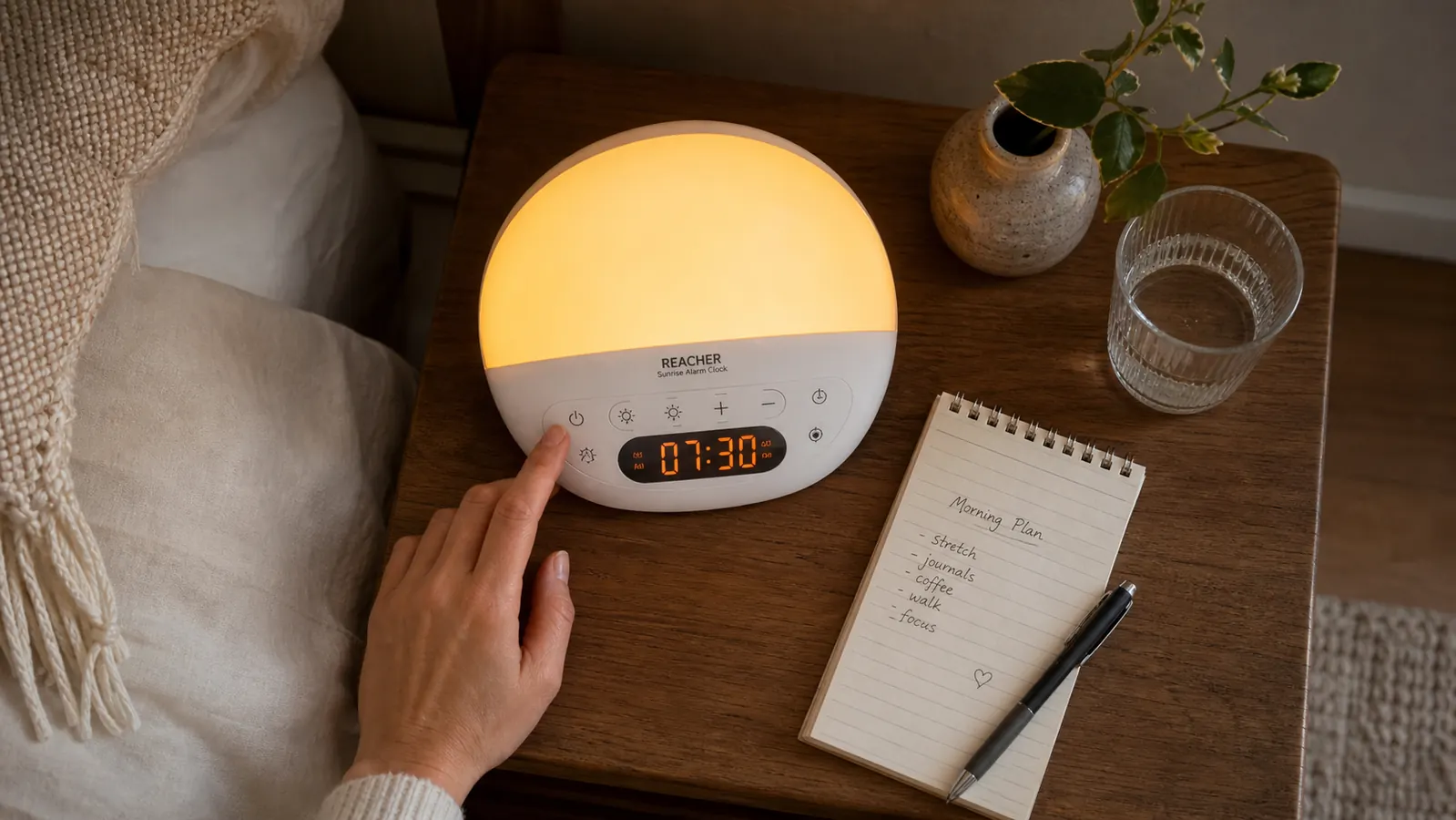
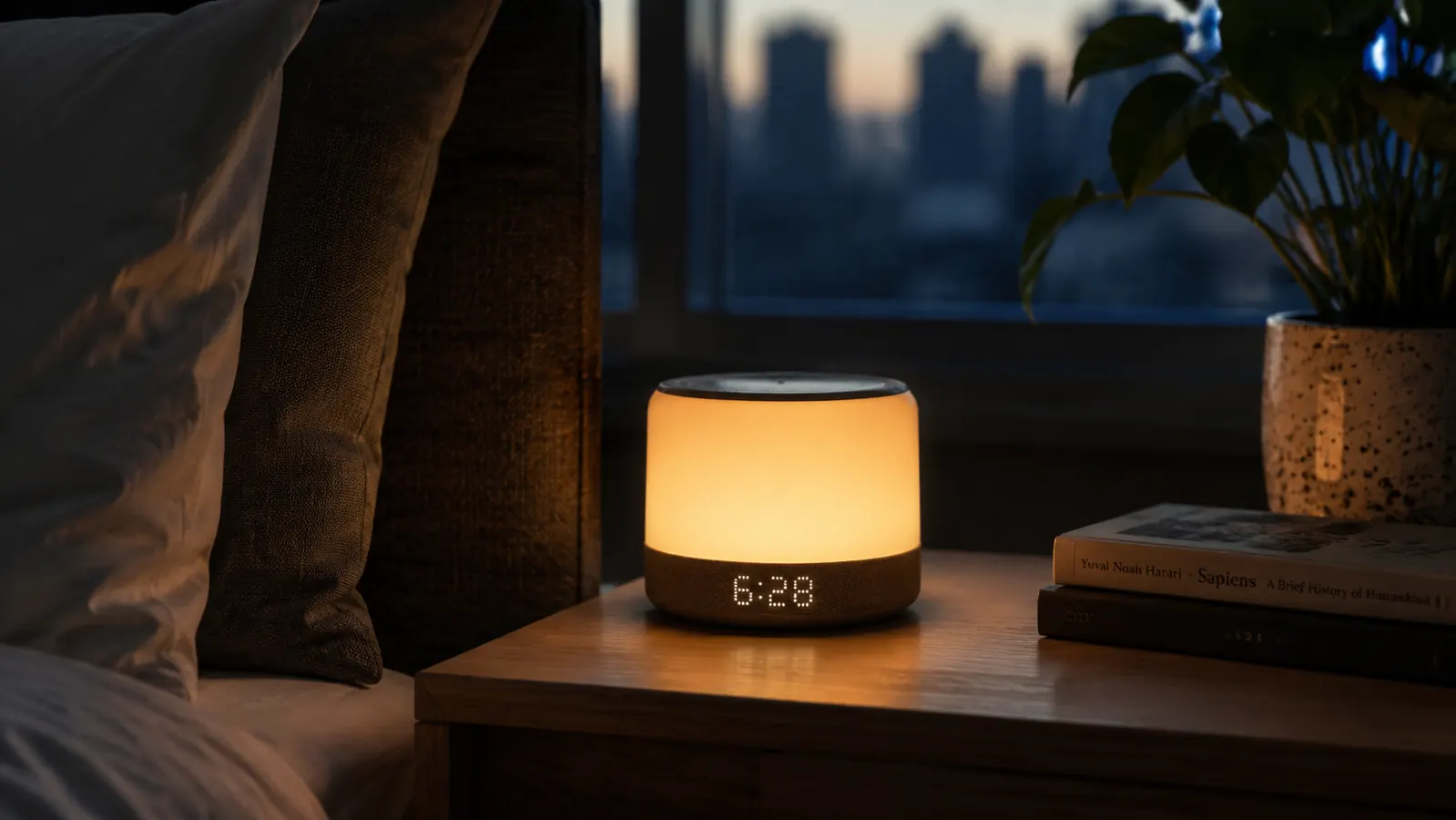
I bought the REACHER sunrise alarm clock, which is a wake-up light and sound machine in one compact unit, because I had spent two years starting every morning with a jolt. My phone alarm was set to something mercifully soft but even the gentlest digital chime feels like a small emergency at 6 a.m., and I was tired of that being the first sensation of my day. I wanted to try gradual light instead of sudden sound. What I got was a two-month experiment that genuinely changed my mornings in ways I did not fully expect.
This review covers the full arc of that experience: setup, the adjustment period, what the light actually does at each brightness level, the nature sounds quality, the FM radio, the dual alarm setup, and the real frustrations I ran into along the way. I kept notes. I tracked how I felt getting out of bed each morning on a simple one-to-ten scale. I want you to have the honest version, not just the first-week enthusiasm.
Quick Verdict
A genuinely effective wake-up light that makes mornings feel softer. Button layout takes a week to memorize and the display glow is annoying in a truly dark room, but the gradual sunrise simulation delivers on its core promise.
Amazon Check Today's Price →If jarring alarms are wrecking your mornings, the REACHER is worth a serious look.
Gradual light, 26 built-in sounds, FM radio, dual alarms, no subscription. Check current availability and pricing on Amazon.
Amazon Check Today's Price on Amazon →How I've Used It
I set up the REACHER on my nightstand on a Sunday night in early April and used it every single morning for the next nine weeks. My wake time during the week is 6:15 a.m. I set the light ramp to begin 30 minutes earlier, at 5:45. My bedroom faces north and gets essentially zero natural light until after 7, so the REACHER is working in a truly dark room with no ambient sunrise competing for its job.
My setup: alarm one is the sunrise light alone, starting at zero brightness and climbing to level 8 out of 10 over those 30 minutes. Alarm two, set five minutes after the light finishes its ramp, uses a gentle bird sound at medium volume as the backup in case the light alone does not do the job. Most mornings I was waking naturally sometime between the two alarms. That felt like a win.
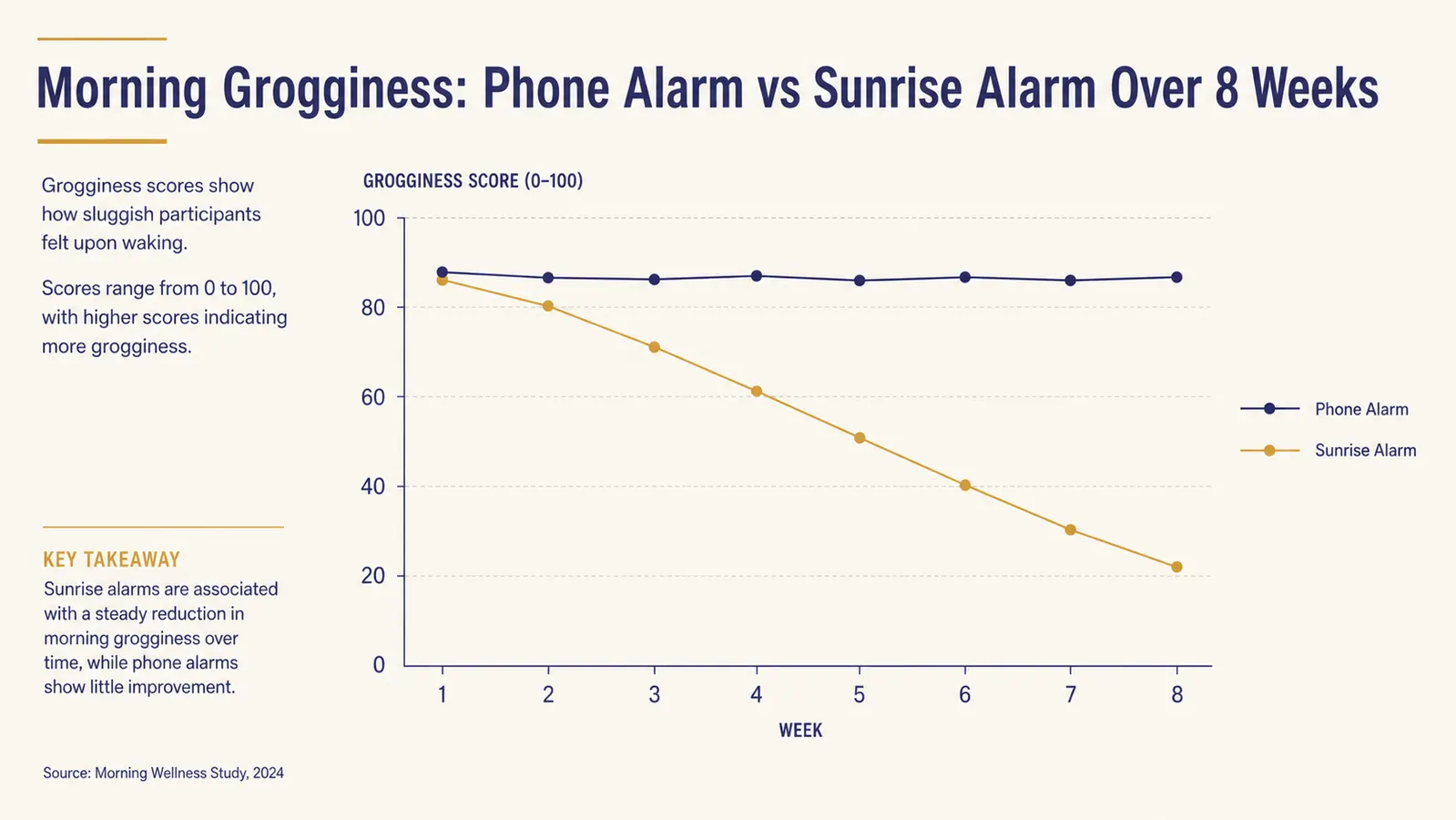
I tracked my morning grogginess on a ten-point scale every day, ten being barely functional. In the first two weeks my average was 6.4, which is roughly where I had been with my phone alarm. By weeks five through nine, my average had dropped to 4.1. Some of that is placebo effect and I acknowledge that honestly. But some of it also felt like genuine physical ease, the difference between surfacing slowly from sleep versus being yanked out of it.
What the Gradual Sunrise Simulation Actually Does
The REACHER's core feature is the light ramp, and it is the right place to start. You can set the sunrise duration to 10, 20, or 30 minutes. I used 30 minutes consistently. At the beginning of the ramp the light is barely visible, a faint warm glow that would not wake a sleeping partner who was not ready to get up. By the midpoint it resembles the soft light of a cloudy sunrise, present but not aggressive. At full brightness on the highest setting, which is level 10, it is legitimately bright. Bright enough to light up a small bedroom.
What surprised me was how the light interacts with the body's natural waking process. On mornings where I had slept well and was near the end of a sleep cycle, the gradual light was enough to pull me up on its own, no sound alarm needed. On nights where I had slept badly or gone to bed late, the light helped but the sound backup still mattered. This is not a magic device. It works with your sleep, not instead of it. If you are running on five broken hours, a sunrise alarm clock is going to make those five hours feel marginally nicer to end, not fix the underlying problem.
The color temperature of the light shifts slightly during the ramp, starting in a warmer amber range and moving toward a cooler daylight tone as it brightens. It is a subtle shift but it feels more natural than a light that just gets louder in one fixed color.
The difference is not dramatic. It is just a little less awful, every single morning, without exception. Over two months that adds up to something real.
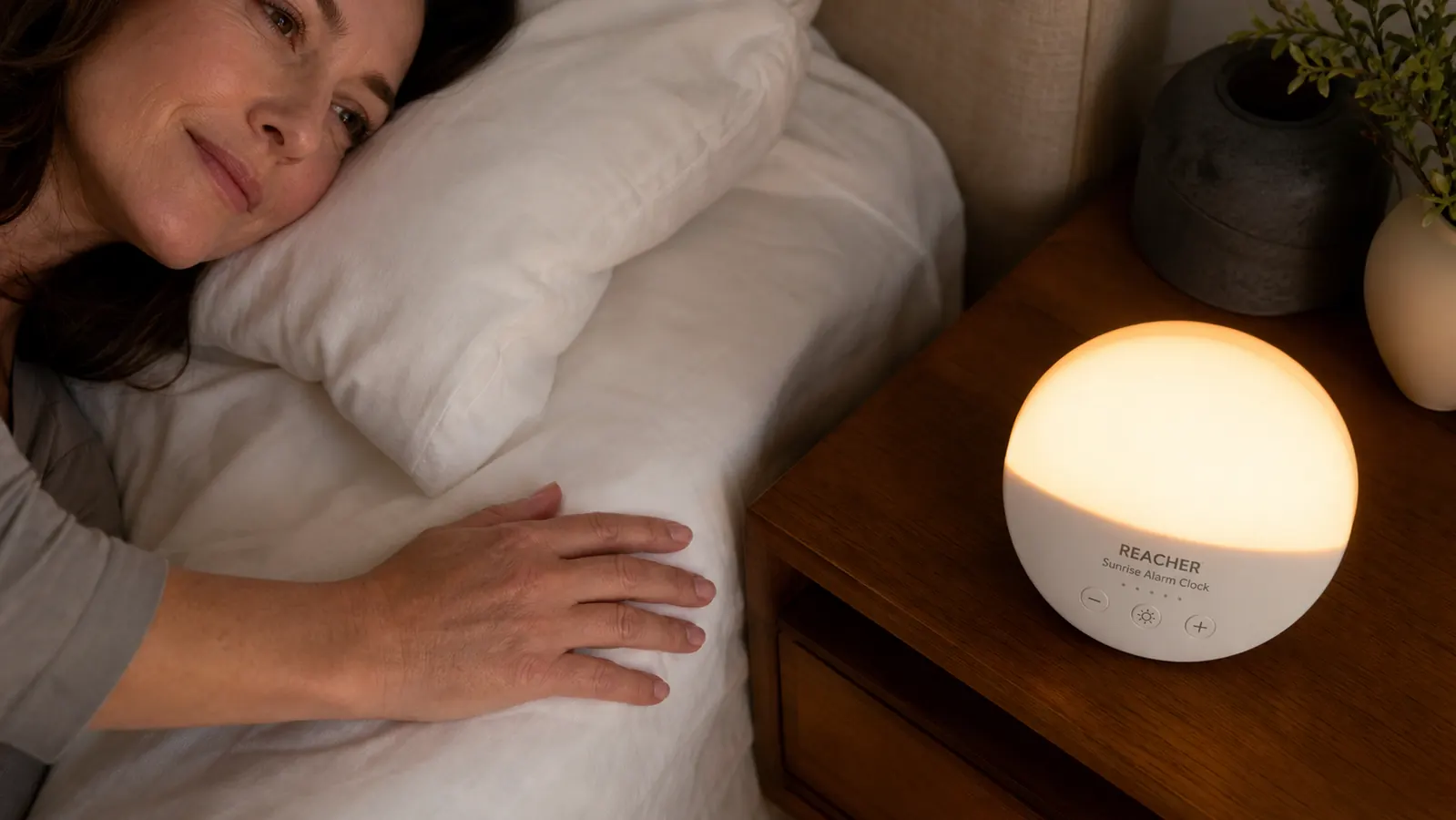
The Sound Machine and FM Radio
The REACHER has 26 built-in nature sounds organized across categories: birds, rain, ocean, white noise variants, campfire, and a few others. The sound quality is good for a small bedside unit. The rain sounds are the best of the bunch, layered enough to feel realistic rather than looping obviously. The ocean sounds are serviceable. The campfire sound is pleasant for winding down but I would not use it as an alarm backup.
The FM radio is a genuine surprise for a product at this price. Signal quality depends entirely on your location and how you position the unit, but in my apartment the radio pulled in clearly on a handful of stations I actually listen to. I used it a few mornings as a lighter alternative to the nature sounds. The tuner interface is simple: hold a button to scan, release to lock. Not slick but functional.
The sound machine also works independently as a sleep aid. I ran the rain sound for 30 minutes as I fell asleep a handful of nights during the test period. It is not going to replace a dedicated white noise machine with a stronger speaker and a continuous loop, but it is genuinely usable for light sleepers who want a little ambient cover without a separate device on the nightstand.
The Frustrations I Cannot Ignore
The button layout took me a full week to stop second-guessing. There are six physical buttons on the top and side panels, and because the unit is a cylinder, some of the top buttons feel identical by touch in a dark room. In the first few days I accidentally adjusted the brightness when I meant to hit snooze, and I reset the alarm time once trying to change the volume. None of this is a dealbreaker. By day ten I had it memorized. But the learning curve is real, and if you tend to fumble with devices in a half-asleep state, plan for a few frustrating early mornings.
The display glow is the thing I most wish REACHER had addressed. The clock display, even at its dimmest setting, emits enough blue-white light to be noticeable in a completely dark bedroom. I am a light-sensitive sleeper and I ended up setting the display to its lowest brightness and pointing the clock slightly away from direct eyeline. It helped, but it did not fully solve it. If you sleep with a sleep mask you will never notice. If you sleep without one in a pitch-dark room, this matters.
Maximum brightness on level 10 is legitimately bright, which is mostly a good thing, but in a very small bedroom it can feel like a studio light at full ramp. I found level 8 was my sweet spot. A brightness cap closer to level 8 would feel right for most users. The fact that it goes higher than most people need is not a flaw exactly, but worth knowing.
Setup involves setting the time, alarm one, alarm two, selecting the light duration, choosing a sound, and adjusting volumes separately for the sunrise alarm and the sound machine function. First-time setup takes about 15 minutes with the manual in hand. It is not complicated but it is also not intuitive out of the box, and the manual is brief. I recommend sitting down with it during daylight before you depend on it the next morning.
Pros
- Gradual light ramp genuinely eases the waking process, especially on good-sleep nights
- 30-minute sunrise duration is long enough to pull you up before the sound alarm fires
- 26 sounds covers rain, birds, ocean, and white noise variants all in one unit
- FM radio works cleanly and is a genuinely useful bonus
- Dual alarm setup handles weekday and weekend schedules without reprogramming
- No app, no subscription, no connectivity required
- Compact footprint for a multi-function bedside device
Cons
- Button layout requires a learning period, easy to press wrong button in the dark
- Display glow is noticeable in a truly dark bedroom even on lowest setting
- Level 10 brightness is more than most small bedrooms need
- First-time setup is fiddly with a thin manual
- Sound speaker is adequate but not a replacement for a dedicated white noise machine
How It Compares to What I Used Before
Before the REACHER I used my phone alarm, a gentle chime tone, alongside a separate white noise machine. My phone sat face-down on the nightstand to avoid display glow, but even face-down it emitted enough light to register. The transition to the REACHER consolidated two devices into one, which I appreciated, though the white noise machine I replaced it with did have a better speaker.
What the phone alarm could never do is what the REACHER does well: the gradual shift from dark to light that gives your body a heads-up before the day formally begins. There is no version of a phone alarm that replicates that, short of a smart home setup with connected bulbs and voice assistants, which costs significantly more and requires ongoing maintenance. The REACHER is a self-contained, press-a-button solution. That simplicity is most of its value. For a deeper look at how a sunrise clock stacks up against a regular alarm on a feature-by-feature basis, the comparison piece on this site covers that in full detail.
Who This Is For
The REACHER sunrise alarm clock is a good fit for people who wake up in a dark bedroom and have grown tired of the jolt that comes with a sound-first alarm. It works best if you are a reasonably consistent sleeper, going to bed around the same time each night, because the light ramp works with your sleep cycle rather than brute-forcing you awake. Light sleepers who live alone or share a bed with someone who wakes at the same time will get the most out of it. It is also a reasonable choice for anyone who travels with their own alarm and wants something that does not require a phone on the nightstand.
It pairs especially well with a sleep eye mask used for falling asleep, removed at some point during the night, so the light can reach you naturally during the ramp. That combination, light-blocking mask while falling asleep, sunrise lamp to wake naturally, covered the two biggest parts of my sleep routine in a way that felt coherent rather than patchwork. If you are also dealing with sound sensitivity and want to understand how a sunrise alarm clock fits into a broader quiet-bedroom setup, the piece on 10 reasons a sunrise alarm clock makes mornings easier walks through the case in more detail.
Who Should Skip It
If your bedroom gets real morning light before your alarm time, the REACHER's artificial sunrise will compete with the real one and lose some of its effect. It is designed for dark rooms. If you share a bedroom with a partner who wakes significantly later than you, the light ramp will also affect them, and that can be a problem worth solving differently, perhaps with a sunrise alarm clock that uses a directional lamp or a personal sleep mask for the partner.
If you are a very heavy sleeper who regularly sleeps through multiple alarms, the gradual light approach is not your primary tool. You need a loud sound alarm as your anchor, with the sunrise light as a pleasant bonus rather than the main event. The REACHER can play that supporting role, but it is not built to drag you out of deep sleep the way a jarring buzzer is. Be honest with yourself about which category you fall into before you buy.
Two months in, I would buy the REACHER again. Mornings are quieter and less rough.
If a gentler start to the day sounds like something worth trying, the REACHER sunrise alarm clock is a low-stakes way to test the concept. Compact, no subscription, no app required. See current pricing and availability on Amazon.
Amazon Check Today's Price on Amazon →