I want to be straight with you about the Magicteam white noise machine before you hand over your card: this is a genuinely useful sleep tool that does exactly what it promises. And it has a handful of quirks that 68,000 reviewers mostly glossed over, which means you might be surprised in the first week if you don't know what to expect.
I'm writing this as someone who has now owned two of these units, one for my bedroom nightstand and one I keep on my desk during work-from-home days. I have opinions. Some of them are inconvenient. This is the review I wish I had found before I bought the first one.
Quick Verdict
A surprisingly effective noise-masker at a price that makes it easy to recommend with minor caveats around the status light, the power cord dependency, and a couple of sounds with audible loop points.
Amazon Check Today's Price →If you've been sleeping through noise problems for months, this is the simplest fix that actually works.
The Magicteam sound machine is one of the top-rated white noise options on Amazon for a reason. Check the current price and availability before you decide.
Amazon Check Today's Price on Amazon →The Thing Nobody in the Review Section Warns You About
Let me lead with the surprises, because the product page photos don't tell you any of this.
First: there is no battery. The Magicteam runs only on AC power through a USB cable and the included wall adapter. That is fine for a permanent nightstand setup. It is less fine if you were picturing it on a camping trip, in a travel bag, or in a room where your outlets are on the far wall. The product page does list the AC power requirement in the specs, but it's buried several screens down and most people don't read it until after the box arrives. Now you know.
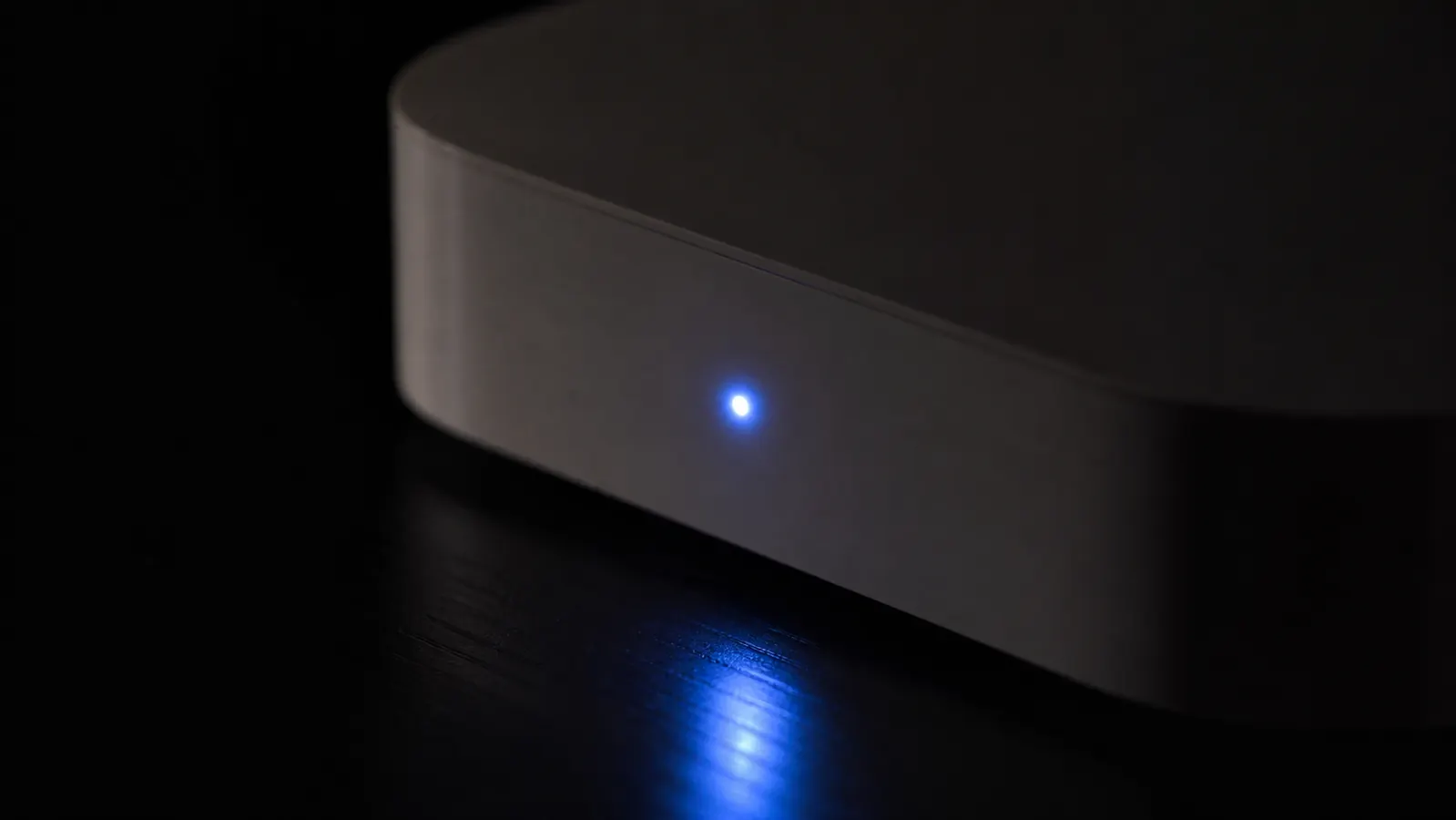
Second: the status light. There is a small LED on the front of the unit that glows blue when the machine is on. It does not turn off. It is not bright enough to bother most people in a fully dark room, but if you are a light-sensitive sleeper who just spent money on a 3D sleep mask, this little indicator is going to register. My first week I solved it with a small piece of black electrical tape over the LED. That worked fine. I just want you to know it's there.
Third: the memory function has a catch. When the unit is unplugged and replugged, some people report that their volume and sound selection hold, and others report that the unit resets to a default. My first unit was inconsistent about this. My second unit holds settings reliably. The inconsistency seems to be a unit-level variance rather than a design flaw across the product line, but it's worth knowing that memory reliability is not guaranteed.
How I've Actually Used It
My bedroom backs up to a fairly busy street in a mid-sized city. Buses run until midnight. Garbage trucks come at 5:30 AM. My upstairs neighbor has, as far as I can tell, furniture with wheels that he rearranges at random hours. I started using the Magicteam sound machine about eight months ago specifically to create an audio buffer between me and that neighbor.
I've run the White Noise, Brown Noise, Rain, and Fan sounds on rotation across those eight months. The Brown Noise is my everyday default now. It sits in a lower frequency range than White Noise and feels less fatiguing over a full night. The Fan setting is a good option if you want something that sounds closer to ambient room air without actually running a fan.
Volume is where you'll need to experiment. Too quiet and it doesn't mask anything. Too loud and the sound machine itself becomes something you're aware of as you fall asleep. For me, about 60 percent of the maximum volume is the sweet spot in a medium-sized bedroom. That number will be different for you depending on your room size, your noise source, and how sensitive your ears are. Plan on three or four nights of adjustment before you land on the setting that disappears into the background.
The 20 Sounds: What's Actually Useful and What to Skip
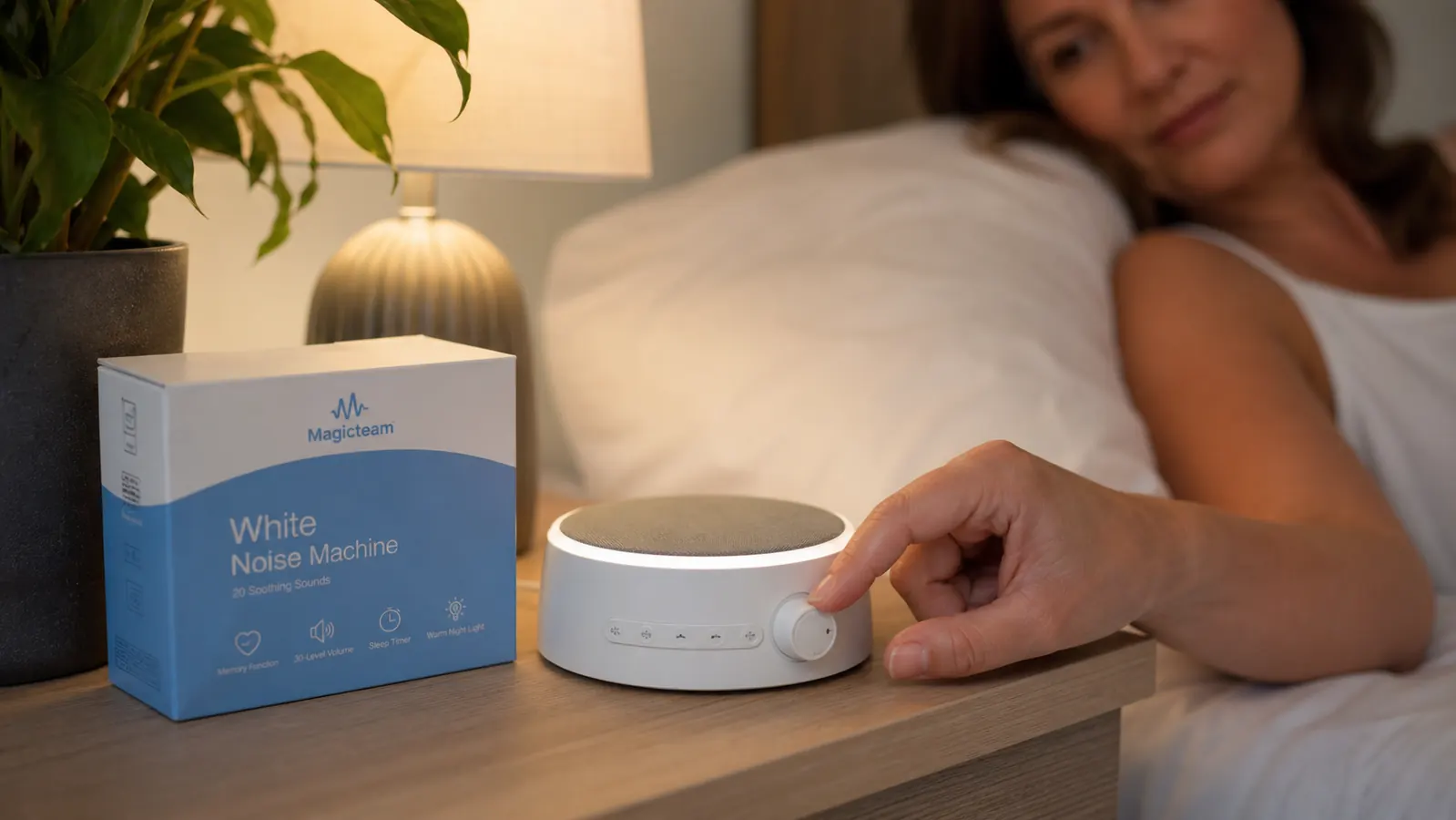
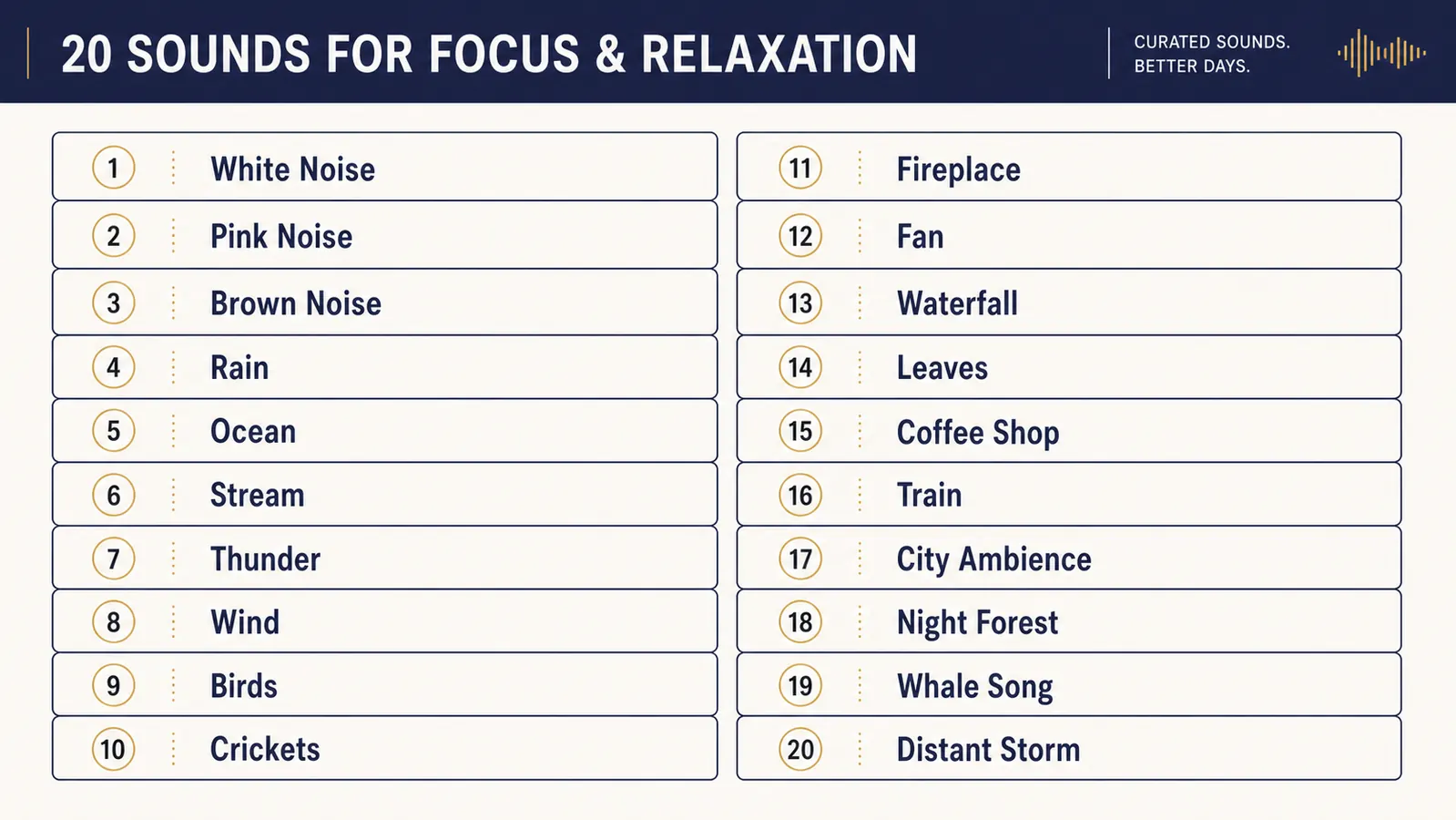
The Magicteam ships with 20 sounds across several categories: white, pink, and brown noise; rain, ocean, stream, and thunder; wind, birds, fire, and crickets; plus a handful of others. That breadth is one of its real selling points, because the sound that works best for masking varies by the type of noise you're trying to cover.
Here is my honest tiered breakdown after several months of rotation. The White Noise, Pink Noise, Brown Noise, and Fan tracks are the workhorses. They are continuous, they mask consistently, and they sit at a steady volume level across the night. The Rain track is also very good and genuinely continuous-sounding. The Ocean and Stream tracks are pleasant for relaxation but have a subtle loop point if you're listening attentively at low volume. It's not jarring, but if you're a light sleeper who notices sound patterns, you may catch the cycle on the Ocean sound in particular. The Thunder and Bird tracks are more for ambience than masking, and I wouldn't rely on them for blocking a noisy apartment.
The loop point on the Ocean track is the single most frequently mentioned complaint in the verified-purchase reviews. It is real. It is also easy to avoid by just not using that track. The core masking sounds don't have this issue, which means the loop problem affects only a narrow slice of the sound library rather than the machine's core function.
What the Volume Dial Gives You and Where It Tops Out
The Magicteam is not the loudest white noise machine on the market. This is relevant if you are trying to mask a genuinely loud environment, a snoring partner right beside you, or thin-walled construction where bass frequencies carry through. The maximum volume is sufficient for most apartment noise and light street sounds. It is not sufficient if you share a wall with someone running power tools or if you live adjacent to an active bar or highway.
I measured my unit at the maximum setting from two feet away. It sits around 65 to 68 decibels depending on the sound selected, which is in the range of normal conversation. That is enough to cover a TV next door and a snoring partner, but do not expect it to silence heavy construction or a shared-wall nightclub. If you need something louder, the LectroFan or the Marpac Dohm are worth looking at as alternatives, though both cost noticeably more.
At about 60 percent of maximum volume, the Brown Noise track disappears into the background of my bedroom. That's the sweet spot. Below that, you can still hear the neighbor. Above that, the machine itself becomes the thing you notice.
Timer: The One Feature That Honestly Should Be Better
The Magicteam has a timer function with three options: 60, 90, or 120 minutes. You cycle through them by pressing the timer button. That covers the typical fall-asleep window for most people, and if you tend to drift off within an hour of lying down it works perfectly fine.
What it does not have is a continuous-play mode you can set once and forget, combined with a scheduled on/off timer. If you want the machine to turn on automatically at 10 PM and run until 6 AM every night without you touching it, you will need a smart plug. That is a reasonable workaround and adds minimal cost, but it's worth knowing that the machine itself has no scheduling capability. It also has no companion app, which I mention only because some people expect it at this category of device.
You can also press no timer button at all and the machine will simply run continuously until you unplug it or press the power button. That is what I do most nights. I just leave it on the nightstand, plugged in, running Brown Noise from around 9:30 PM until my alarm goes off. It works well that way, and the power draw is low enough that leaving it on overnight isn't a concern.
Build Quality and What to Expect Physically
The Magicteam is a small, lightweight cylinder roughly the size of a large coffee mug. The housing is matte white plastic that feels appropriately sturdy for something that sits stationary on a nightstand and never gets picked up. The dial has a soft detent feel that lets you make small volume adjustments in the dark without overshooting. The sound buttons cycle through options with a single press; there is no display showing which sound you're on, which means you'll need to orient by counting button presses in the dark if you change sounds after lights-out.
The included USB cable is a standard type, about five feet long, which is enough to reach most nightstand outlets without an extension. The unit generates a small amount of heat during operation, concentrated at the back near the speaker. After eight months of continuous overnight use, both of my units are still working without any degradation in sound quality or volume.
Pros
- Continuous-play noise tracks (White, Pink, Brown, Fan, Rain) mask apartment noise effectively with no audible loop
- Brown Noise and Pink Noise feel less fatiguing than classic White Noise across a full night
- 20 sound options give enough variety to find one that works for your specific noise environment
- Volume dial allows fine-grained adjustments in the dark without waking a partner
- Small, lightweight footprint fits cleanly on a crowded nightstand
- Current price makes it easy to buy one for each bedroom without budgeting stress
- Simple interface with no app, no Bluetooth pairing, no account required
Cons
- No battery power: requires a wall outlet at all times, not travel-friendly
- Status LED stays on while the machine runs; light-sensitive sleepers may notice it in a dark room
- Ocean and Stream tracks have an audible loop point at low volumes (avoid these two sounds if looping bothers you)
- Volume ceiling is moderate: not powerful enough for very loud shared-wall environments or heavy street noise
- No scheduling timer or smart-home integration built in; requires a separate smart plug for automated on/off
- No display showing active sound selection; navigating in the dark requires counting button presses
- Memory reliability across power outages may vary by unit
Who This Is For
This machine is the right call if your sleep problem is moderate noise: a snoring partner, street traffic at the lighter end, an upstairs neighbor with a normal walking pace, or a house that creaks. It is also right for anyone who has been using a box fan as a white noise source and wants to stop moving air around the room in winter. It is right for parents who want consistent sleep sound for a baby's room without paying for a nursery-specific device that costs twice as much.
It is a good fit if you appreciate simplicity. There is no setup ritual here. You plug it in, press the sound you want, set your volume, and that is the entire process. If you have been putting off buying a white noise machine because the options feel complicated or you're not sure which one to trust, this is the one to start with. The rating and the review count are high for a reason: most people who buy this machine use it and keep it.
Who Should Skip It
Skip this one if you are an extreme light sleeper who cannot tolerate any light source in the bedroom. The status LED is small but it exists, and no amount of tape is a perfect long-term fix if that detail is going to bother you consistently.
Skip it if you need battery power for travel or off-grid use. There are dedicated travel sound machines with internal batteries that fit this use case better. Skip it if your noise environment is genuinely severe, meaning you share a wall with a loud commercial space or your bedroom is directly adjacent to highway-level traffic. The volume ceiling on this unit will not be enough and you'll be disappointed. And skip it if you want a fully scheduled smart-home device that turns on and off on a calendar without a separate smart plug in the circuit.
For everyone else, this is one of the more honest value propositions in sleep accessories. The things that work about it work reliably, and the things that don't work are easy to know about in advance, which is exactly why I wrote this.
If you want more context on how it compares against running a basic fan overnight, see our breakdown in White Noise Machine vs Fan for Sleep. If you're on the fence and want a quick read on how other people got past that fence, the story of making a loud apartment livable again might help.
You've been losing sleep to a noise problem that a small sound machine would have solved months ago.
The Magicteam sound machine is worth trying. Check today's price on Amazon and see if it's still in stock.
Amazon Check Today's Price on Amazon →