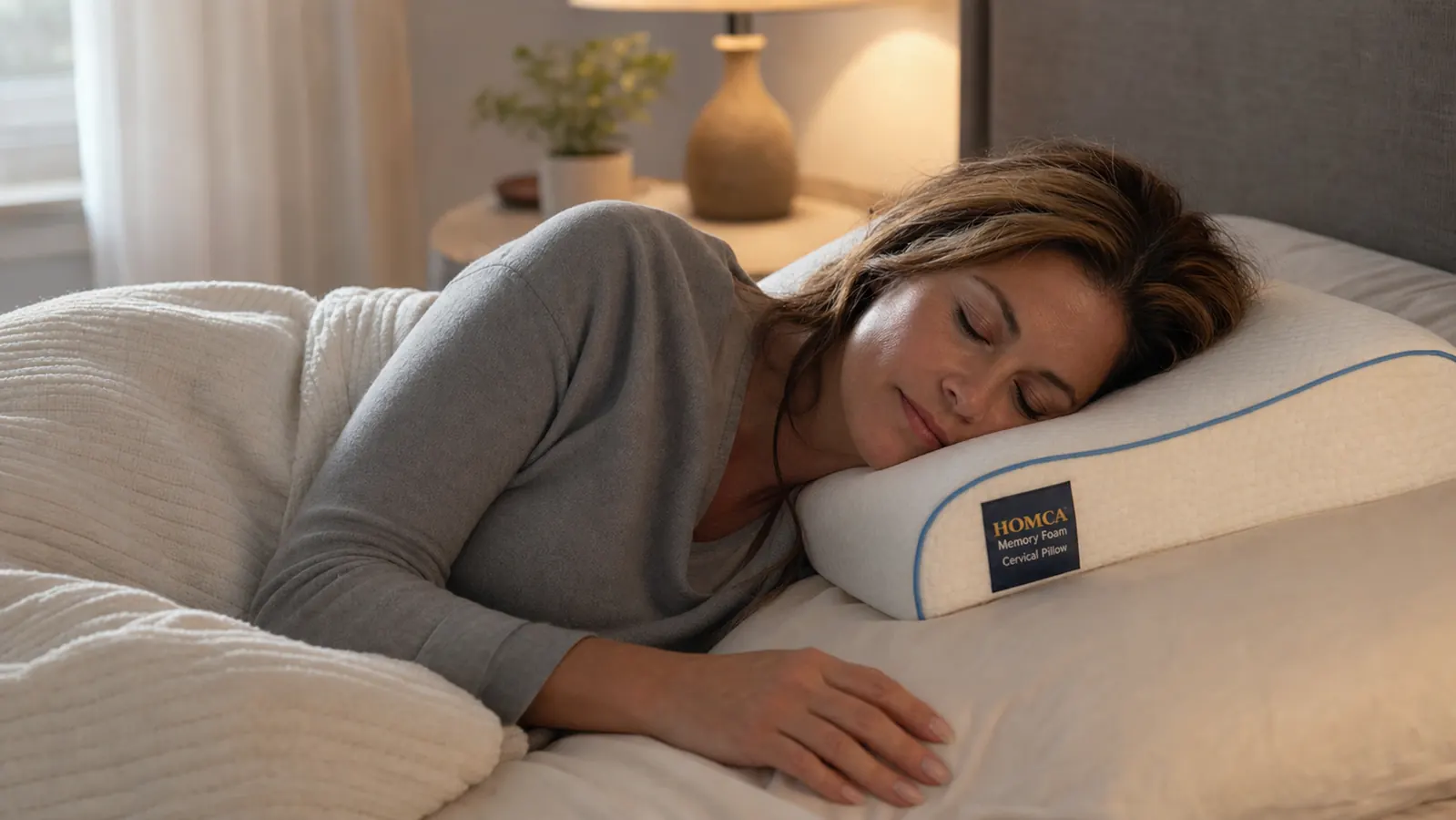
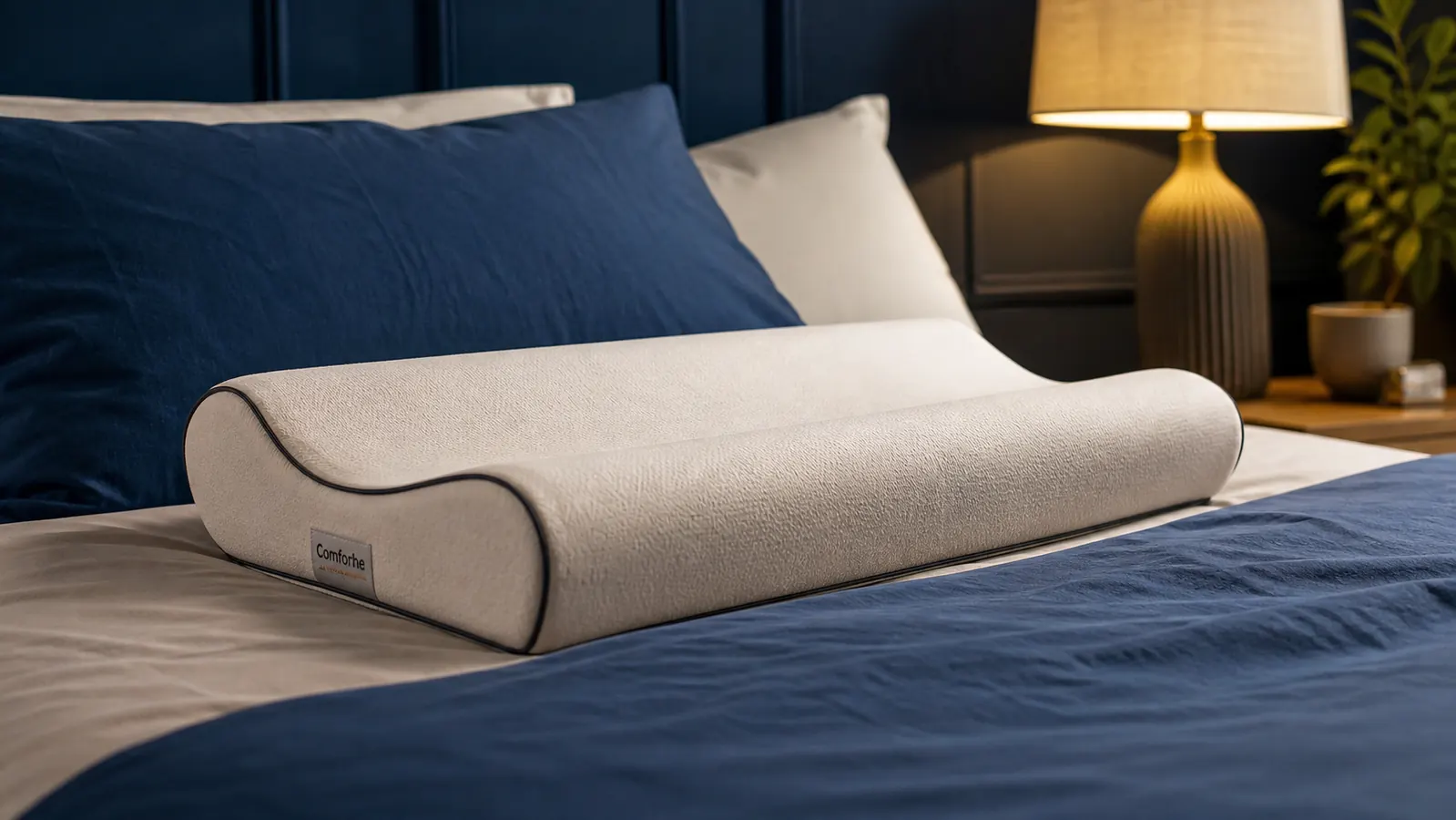
The HOMCA cervical contour pillow and I got off to a rough start, and I think that is exactly the right place to begin this review. Within the first two minutes of opening the packaging, I pressed my hand into the foam, felt how firm it was, noticed a distinct chemical off-gassing smell, and genuinely wondered if I had made a mistake. That first impression is one of the most common experiences buyers mention in one-star reviews, and it is also the experience that almost entirely disappears if you give the pillow seventy-two hours and good ventilation. Most reviews do not explain that gap. This one will.
I want to be specific about who I am because it matters for how you read this. I am a back sleeper who occasionally drifts to my side. I have broad shoulders for my height, which means I have been through several pillows that were genuinely fine for average-width frames but left me with a kink in my neck because the loft was too low for my shoulder clearance. When I tried the HOMCA cervical contour pillow, understanding that loft-to-shoulder-width relationship changed everything about how I selected the right configuration. If no one has told you that loft selection is the single most consequential buying decision you will make with this pillow, consider this your advance notice.
Quick Verdict
A well-engineered cervical pillow that genuinely rewards patience. Side and back sleepers who select the right loft for their shoulder width and get through the first week will likely never go back to a flat pillow. Stomach sleepers, hot sleepers, and anyone who hates a break-in period should look elsewhere.
Amazon Check Today's Price →Still not sleeping through the night? Your pillow might be the one thing nobody has told you to fix.
The HOMCA memory foam cervical contour pillow has nearly 12,000 Amazon ratings and comes in multiple loft heights. Check today's price and compare the size options before you add it to your cart.
Amazon Check Today's Price on Amazon →The Off-Gassing Smell Nobody Mentions in the Product Description
The first thing you will notice when you open the HOMCA packaging is a sharp, slightly chemical foam smell. It is not overwhelming by any standard, and it is exactly what you get with any dense memory foam product that has been compressed in vacuum-sealed packaging for weeks or months. The smell is off-gassing from the foam itself and from the compressed packaging, and it dissipates on its own. What matters is how quickly you address it.
The best approach is to unwrap the pillow and leave it somewhere with good airflow for a full forty-eight to seventy-two hours before sleeping on it. A spare room with a window cracked, or even a dry outdoor area out of direct sun for a few hours, works well. People who put the pillow directly on their bed and sleep on it that first night are the ones most likely to report a strong smell keeping them awake. The smell genuinely goes away. But if you do not let it off-gas first, you are setting yourself up to hate a pillow that is actually fine.
Firmness and the Break-In Period: What to Actually Expect
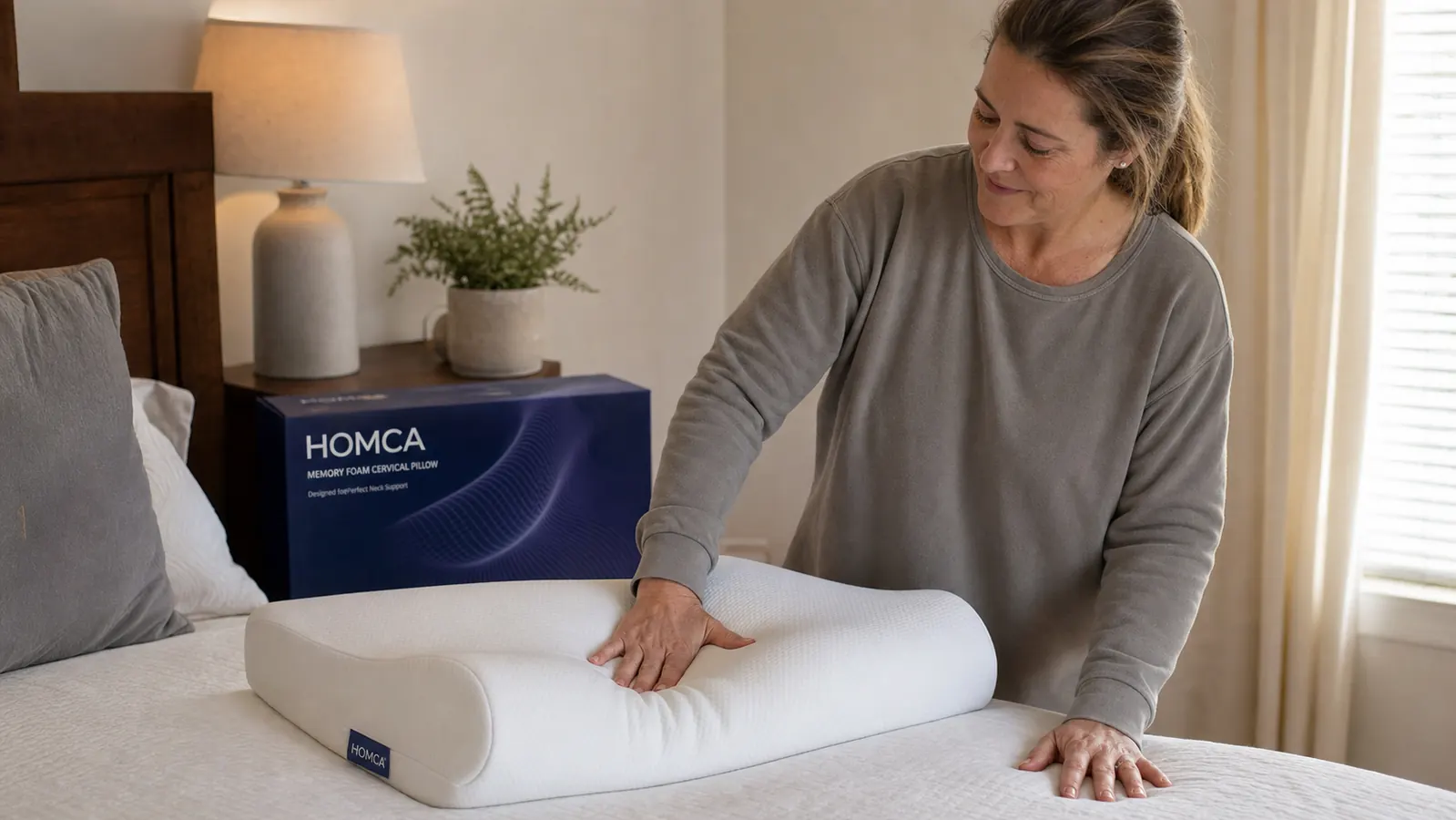
Reviewers who give the HOMCA one or two stars within the first few days are almost universally reacting to the initial firmness. I understand the instinct. You press the foam and it barely moves. You rest your head on it the first night and it feels like resting your head on a very dense foam block rather than a pillow. This is real, it is temporary, and it is not a sign of a defective product.
Dense memory foam responds to heat and sustained pressure, not to brief hand-squeezes. Your body heat, applied over the course of several full nights of sleep, is what triggers the foam to soften and begin conforming to the shape of your head and neck. By night four or five most people notice the foam feels materially different at bedtime than it did on the first night. By the end of the second full week the foam has settled into a stable, personalized shape that is noticeably more comfortable than the initial firmness suggested it would be. The break-in period is real. It is also finite. Plan for ten to fourteen days before drawing any firm conclusions.
One thing worth knowing: the break-in process works better if you sleep on the pillow consistently every night during that window. Switching back and forth between the HOMCA and your old pillow during the adjustment period extends the break-in timeline and makes it harder to fully adapt to the new shape. Pick a start date and commit to a solid two weeks on the new pillow before deciding whether it is working.
Loft Height and Shoulder Width: The Part Most Buyers Get Wrong
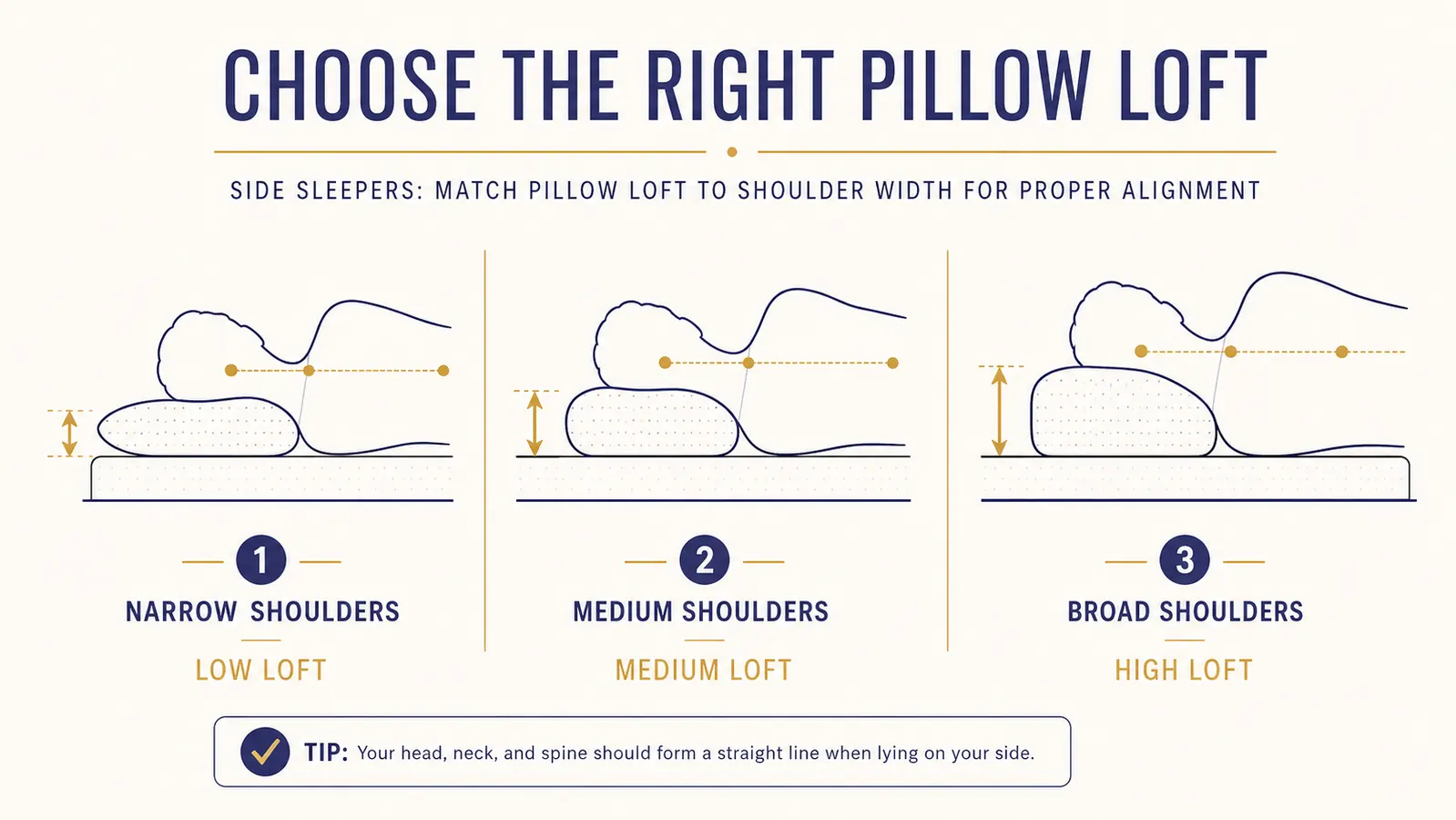
This is the section I wish someone had handed me before I ordered. The HOMCA cervical contour pillow comes in different configurations, and the loft height, meaning how tall the pillow is on the side-sleeping ridge, is not a universal fit. It is matched to the gap between your mattress surface and the side of your head when you are lying on your shoulder.
Here is how to think about it: when you lie on your side, your shoulder creates a gap. The pillow needs to fill that gap without pushing your head up too high or letting it drop too low. People with narrower shoulders need less loft. People with broader shoulders need more. If the loft is too low for your shoulder width, your neck tilts downward overnight, which is exactly the kind of sustained misalignment that leaves you waking up stiff. If it is too high, your neck tilts upward and you get pressure at the base of your skull. Neither outcome has anything to do with pillow quality. Both are about match.
A rough rule of thumb: if your shoulder width is less than 15 inches measured from neck to shoulder tip, the standard loft is usually appropriate. If you are broader, the higher loft option is worth considering. Your mattress firmness also plays a role, since a softer mattress will absorb some of your shoulder and effectively reduce the gap. If your mattress is soft, lean toward standard loft even if you have broader shoulders. Read the HOMCA listing dimensions carefully and compare them against your own measurements before ordering. A ten-second measurement can save you a return.
The break-in period is real, it is temporary, and it is not a sign of a defective product. Plan for ten to fourteen days before drawing any conclusions at all.
The Contour Ridge at Night: How Long It Feels Odd and When It Clicks
The raised side-sleeping ridge is the feature most buyers either love deeply or find disorienting for the first several nights. If you have been sleeping on a flat pillow your whole adult life, your neck has adapted to that specific geometry. When you introduce a pillow with a defined, raised ridge along the outer edge, your body registers the unfamiliar contact point, particularly behind the ear and along the jaw for people who sleep on their side with their face slightly forward.
That pressure-map adjustment is normal and typically resolves within the first week to ten days. What the ridge is doing during those early nights is holding your head at a consistent height rather than allowing it to slowly sink as the night progresses. The slight unfamiliarity you feel is the pillow doing its job consistently when your body was expecting something to give way. Once your body stops anticipating the give that never comes, the ridge stops feeling like a ridge and starts feeling like support. That shift usually happens around night six or seven for most people.
Heat Retention: How Warm Does It Actually Sleep?
Dense memory foam traps heat. This is not a manufacturing defect and it is not something HOMCA can fully engineer away, because the thermal properties that make memory foam respond to body heat are the same properties that make it hold warmth against your skin. What HOMCA has done to address this is include a dual-sided cover: one side is a smooth cooling-fabric weave and the other is a softer textured knit for cooler nights. The cooling side does make a real difference. It is not a cure-all for people who run genuinely hot at night, but for average-warmth sleepers it keeps the surface temperature from becoming a problem.
Where things get harder is in warm-weather months or in rooms that run above 70 degrees Fahrenheit at bedtime. Under those conditions the foam itself holds heat in a way the cover cannot fully offset. A few nights I woke up at around 3am with my neck noticeably warmer than the rest of my pillow and needed to briefly flip to the cooler side. This happened maybe two or three times over the course of two months rather than every night, so I do not consider it a dealbreaker. However, if you are already a person who regularly throws off blankets and needs cold airflow to sleep, that 3am heat wakeup is likely to happen more frequently for you than it did for me.
Back Sleepers, Side Sleepers, Stomach Sleepers: Which Position Actually Works Here
Back sleeping is where the HOMCA shines most cleanly. The lower contour wave is shaped specifically for this position, and the curved central cradle supports the base of your skull in a way that distributes the weight of your head more evenly than a flat pillow does. If you are a dedicated back sleeper who has been on a flat pillow, the transition to the HOMCA's back-sleeping contour tends to feel natural faster than it does for side sleepers because the height adjustment required is smaller.
Side sleeping takes longer to settle but ultimately works well when the loft is matched correctly to shoulder width. The key discovery most side sleepers make after week two is that they are moving around less during the night. A flat pillow compresses under your head over the course of several hours, which means your neck drops gradually, your body registers the discomfort somewhere around 3am, and you shift. The HOMCA's fixed foam maintains the same height from the moment you lie down to the moment your alarm goes off, which eliminates that gradual drop and the micro-wakings that come with it.
Stomach sleepers will have a difficult time with this pillow and should not buy it. The raised ridge forces the neck into an upward angle when lying face-down that creates strain rather than relieving it. This is not a design flaw. The pillow was engineered for side and back positions, and the contour geometry that makes it work well in those positions physically does not work in a prone position. If you are a stomach sleeper who wants to transition to back or side sleeping, this pillow might work as part of that transition. But buying it while intending to stay on your stomach will likely result in a return within a week.
Pros
- Back-sleeping contour distributes skull weight broadly, reducing the concentrated pressure that standard flat pillows create at the base of the head
- Fixed-foam construction prevents the overnight height loss that causes 3am micro-wakings on compressible pillows
- Dual-sided cover with a cooling-fabric surface extends comfortable use into warmer months for average-warmth sleepers
- Nearly 12,000 ratings across multiple years give a meaningful picture of long-term durability, most buyers report the foam holding its shape past six months
- Thoughtfully sized for both back and side sleeping in a single pillow rather than requiring separate purchases for each position
Cons
- Out-of-box off-gassing smell requires a deliberate forty-eight to seventy-two hour airing window before first use, the listing does not mention this
- Initial firmness is genuinely jarring for buyers coming from soft pillows, and the break-in period demands patience most short-term reviewers do not have
- Heat retention is a real issue for warm sleepers, particularly in summer months or heated rooms, where the cooling cover face only partially offsets the foam warmth
- Loft height selection is consequential and not clearly explained in the listing, wrong height choice for your shoulder width undercuts the whole design
- Stomach sleepers cannot use this pillow comfortably and should not purchase it regardless of marketing language about orthopedic support
Who This Is For
The HOMCA cervical contour pillow is a strong match for side and back sleepers who are willing to put in the two-week break-in investment. If you are someone who has been waking up feeling less rested than you expected after a full night in bed, or noticing that the base of your neck and the top of your shoulders carry tension first thing in the morning, this pillow addresses the alignment mechanics that flat pillows do not. It is also a good fit for people who have tried plush or soft pillows and found them comfortable for the first hour but flat by morning. The fixed-foam construction holds its height reliably throughout the night in a way that fill-based pillows simply cannot match. Pair it with the correct loft height for your shoulder width and it tends to deliver on its promise within the first two to three weeks.
Who Should Skip It
Three groups of buyers are likely to be disappointed here. Stomach sleepers should skip this entirely, since the contour geometry is structurally incompatible with face-down sleeping. People who run genuinely warm at night and already find temperature management a nightly challenge will find that the foam heat retention, while manageable for most sleepers, adds friction rather than removing it. And if you are the kind of person who decides within the first four nights whether a product is working, the break-in period on this pillow will end your experiment before the foam has had time to do what it is designed to do. The HOMCA rewards patience and correct setup. Buyers who skip either of those steps tend to leave the negative reviews that confuse people into thinking the pillow is worse than it is.
The adjustment period is real. So is the payoff. Just make sure you pick the right loft height for your shoulder width before you order.
The HOMCA memory foam cervical contour pillow is one of the most consistently reviewed cervical pillows on Amazon across nearly 12,000 ratings. Check today's price and compare the loft height options so you get the right fit for your frame the first time.
Amazon Check Today's Price on Amazon →