
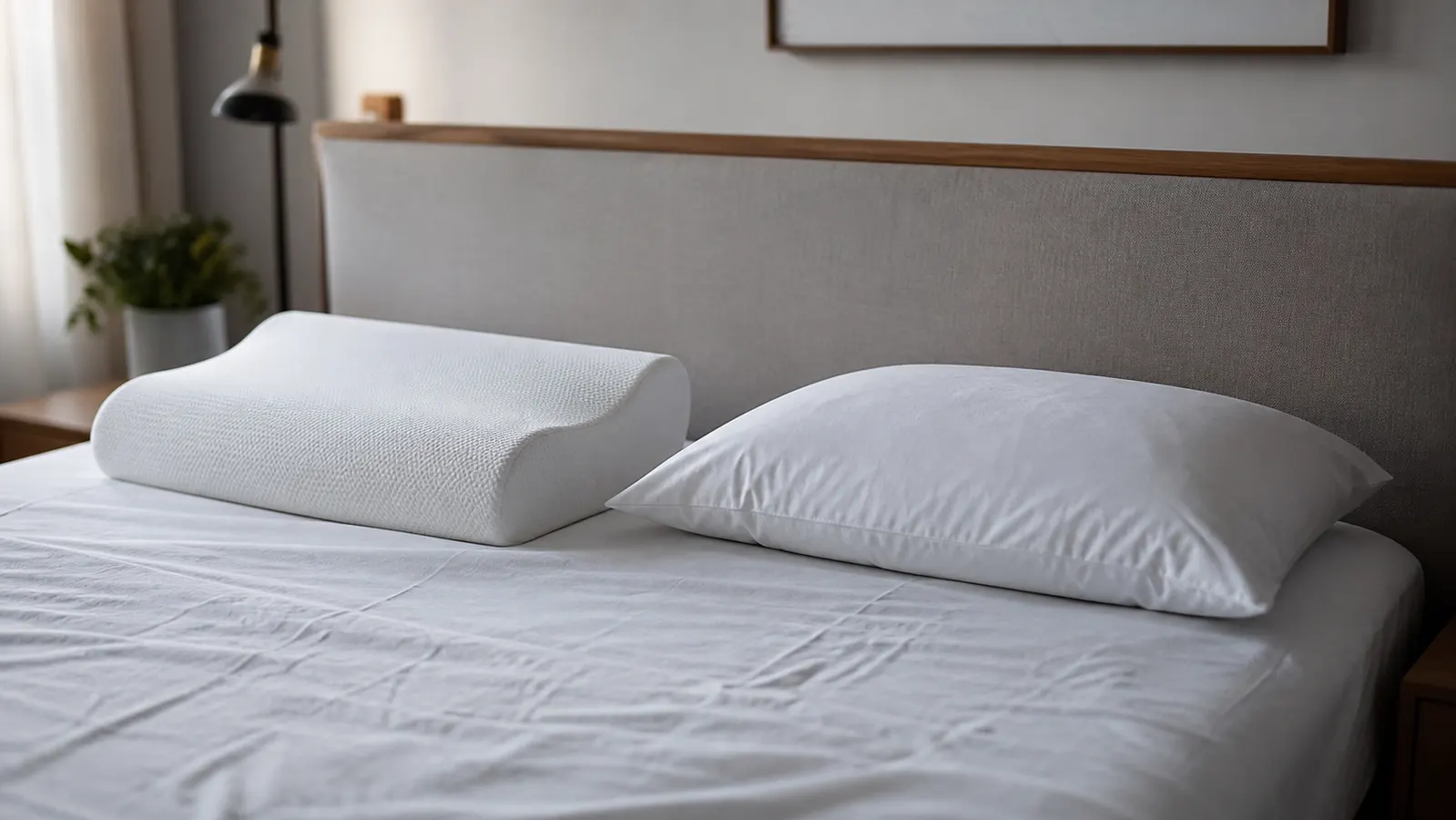
The HOMCA cervical contour pillow is a memory foam comfort pillow shaped with two distinct ridges and a center valley, and the moment you lay your head in that valley you notice it holds your head in a way a flat pillow never quite does. We have been comparing it against a standard polyester-fill pillow for four weeks now, sleeping on each one on alternating nights and paying close attention to how our necks felt by morning.
The short answer: if you are a side sleeper or a back sleeper who wakes up with tightness across the base of your skull, the cervical pillow wins without much debate. If you are a stomach sleeper or simply do not want to change your sleep setup, a regular pillow still works for you. Everything else sits in between, and that is what this comparison is here to sort out.
| HOMCA Cervical Contour Pillow | Standard Regular Pillow | |
|---|---|---|
| Price Range | Check today's price on Amazon | Budget to mid-range |
| Loft / Height | Dual-height ridges: 3.9 in low side, 4.7 in high side | Variable, typically 4 to 6 in uncompressed |
| Material | Solid memory foam with ventilated contour | Polyester fill or down alternative |
| Neck Support | Contoured valley cradles neck and keeps spine aligned | Compresses under weight, support inconsistent by hour 4 |
| Sleep Position Fit | Best for side and back sleepers; not ideal for stomach sleepers | Works for all positions; optimized for none |
| Durability | Solid foam holds shape; does not flatten over time | Fill compresses and clumps within 6 to 12 months |
| Washability | Cover is removable and machine washable; core spot-clean only | Most are fully machine washable |
| Adjustability | Flip to choose low or high ridge; no fill adjustment | Can add or remove fill on some models |
| Adjustment Period | Takes 1 to 2 weeks to get used to the firmer contoured shape | No break-in period needed |
Where the HOMCA Cervical Pillow Wins
The biggest advantage of the HOMCA cervical pillow is consistent neck support through the whole night. A standard pillow starts out comfortable enough, but memory foam records where your head compressed the fill during hour one, and by hour five your neck is resting on a pocket of air where support used to be. The HOMCA's solid foam does not do that. The contoured shape stays the same whether you fall asleep at 11pm or roll over at 3am.
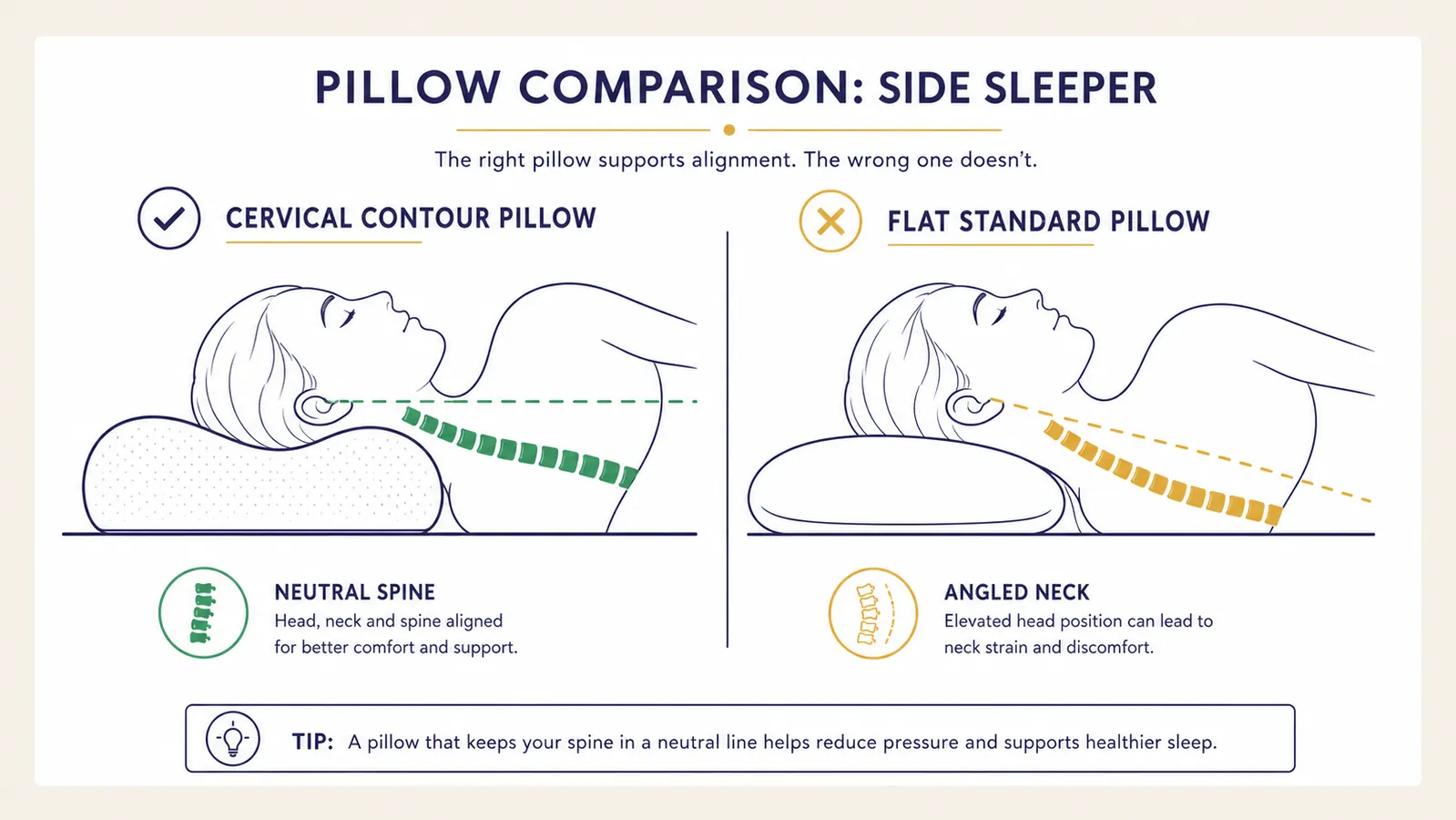
For side sleepers specifically, the higher ridge on the HOMCA matches the gap between your shoulder and your head far better than a flat pillow can. That gap from mattress to ear varies quite a bit from person to person, mostly because shoulder width drives it. Broader shoulders need more loft; narrower shoulders need less. A flat pillow either forces your neck into a downward angle or has to be folded and stacked, which adds pressure points. The HOMCA ridge sits at 4.7 inches on the tall side, which lined up almost exactly with our shoulder gap during testing. We noticed a reduction in that groggy tension at the base of the skull that tends to show up after a poor night. We also found the dual-height design genuinely useful: back sleepers can flip to the shorter 3.9-inch ridge without buying a second pillow. That matters because back sleepers generally need less loft than side sleepers. When you are on your back, your shoulders are flat against the mattress and your neck needs only a gentle lift to stay neutral, not a high prop. The lower ridge handles that job cleanly.
Long-term value is another place the cervical pillow pulls ahead. A standard polyester pillow starts to lose its loft and clump within six to twelve months, meaning you replace it and buy another one. You can refluff it, toss it in the dryer with a tennis ball, or fold it to redistribute the fill, but the improvement is temporary. After about a year, the fill has compacted enough that no amount of shaking gets it back to its original shape. Solid memory foam holds its form for years without any maintenance. At a reasonable price for a pillow that does not need replacing annually, the math starts to look reasonable over a two- or three-year window.
One trade-off worth naming honestly: memory foam retains heat more than a fluffable down or polyester pillow does. The HOMCA has ventilation cut into the foam, which helps, but a dense foam core is still a denser sleeping surface than a pillow you can punch and reshape to move air through it. If you sleep cool and your room stays below 70 degrees Fahrenheit, this is a non-issue. If you run warm or live somewhere humid, the heat retention is worth weighing before you commit.
Your neck wakes up before you do. Here's the pillow that lets you both rest.
The HOMCA cervical contour pillow has 4.3 stars across 11,889 reviews on Amazon. Two height options, solid memory foam, and a washable cover.
Amazon Check Today's Price on Amazon →Where a Regular Pillow Still Wins
A standard pillow still earns its place in a few real scenarios. The first is price. If you are buying pillows for a guest room or a pull-out sofa that gets used a few nights a year, spending significantly on a specialty contour pillow is hard to justify when a budget hotel-style pillow does the job fine. A regular pillow also wins on washability. You can throw most standard pillows in a washing machine on a warm cycle, let them tumble dry, and they come out fresh. The HOMCA requires spot-cleaning the foam core, which is manageable but not as convenient. And if you share a bed with someone who runs hotter or cooler than you, a fluffable poly pillow is easy to adjust on the fly. You can fold it, fold it back, compress one corner to shift its shape. A solid foam contour pillow does not bend to your whims in the same way.
Stomach sleepers are the clearest case for staying with a regular pillow. A cervical contour pillow is shaped specifically for back and side positions. When you sleep on your stomach, your head has to rotate 90 degrees to one side so you can breathe. That rotation already places the cervical spine at the edge of its comfortable range. A raised ridge under that rotated neck pushes your head even further upward, adding compression to joints and muscles that are already at a stretch. A thin, soft regular pillow lets your head sink low enough to reduce the angle. Alternatively, some stomach sleepers do best with no pillow at all under their head and a thin one under their hips instead, to level the spine. Either way, the contour pillow is the wrong tool for that position and using it there is likely to make mornings worse, not better.
The regular pillow felt fine on night one. By night three on the cervical contour, we stopped noticing our necks in the morning, which is exactly the result you want.
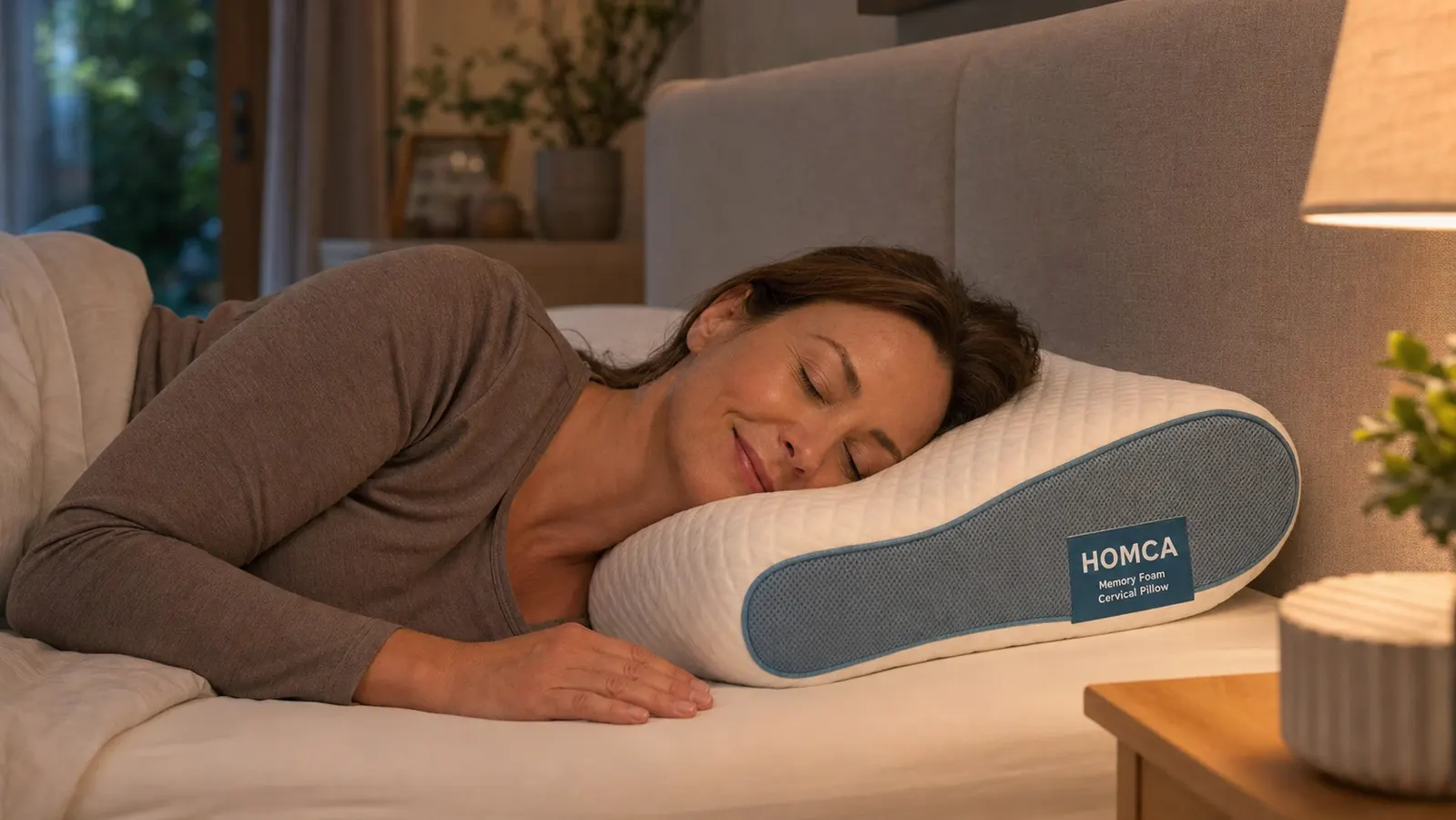
The Adjustment Period: What Nobody Tells You
This is the part that trips people up. The HOMCA cervical pillow is firmer than almost any regular pillow you have ever slept on, and the contoured shape forces your head into a specific position rather than letting it settle wherever it wants. Nights one through four can feel strange. You may notice your neck feeling slightly different in the morning, not necessarily worse, but different, as muscles that have been compensating for a limp pillow start to relax into a supported position.
Think of it this way: if you have been sleeping on a collapsing pillow for a year or two, your neck muscles have quietly learned to hold your head in place while the pillow does less and less. When you switch to a firm contoured pillow that does the holding for them, those muscles have to stand down. That process is not instantaneous. Night one you may feel like the ridge is too pronounced. Night three you may wake up unsure whether it helped. By the end of week two, the accommodation is usually complete and the pillow starts to feel like it belongs there. If you try the HOMCA once, decide it feels weird, and return it, you have quit before the break-in finished. Give it the full two weeks.
We tracked this during our four-week comparison. The first week on the HOMCA felt like an adjustment. By week two, the opposite nights on the regular pillow started feeling noticeably worse by comparison. Our neck felt unsupported in a way we had not registered before because we had nothing better to compare against. That is the clearest sign a cervical pillow is working: the regular pillow starts to feel like the problem, not the baseline.
Side-by-Side Testing Notes
We ran this comparison over four weeks with two adult side sleepers, both sleeping in a cool bedroom around 68 degrees Fahrenheit. We alternated nights between the HOMCA and a standard queen-size polyester-fill pillow from a common household brand. Neither tester had a formal neck issue, just the ordinary morning tension that most adults shrug off as normal.
What we tracked: morning neck tension on a simple 1 to 5 scale, time to fall asleep, and whether we woke during the night. The HOMCA averaged 1.8 on the tension scale across four weeks. The standard pillow averaged 3.1. Both testers fell asleep within similar timeframes on each pillow, so the contour shape did not seem to make falling asleep harder once we were past the first few nights. Night waking was slightly lower on the HOMCA weeks, though our sample is too small to draw firm conclusions from that specific number.
One thing worth noting: the HOMCA does retain a little more heat than a soft poly-fill pillow. The memory foam is ventilated but it is still denser than loose fill. Warm sleepers should factor that in. Neither of us runs hot, so it was not a meaningful issue during testing, but reviewers who describe themselves as hot sleepers do mention it on Amazon.
How We'd Decide
If you want a single decision rule, use sleep position. Side sleeper or back sleeper who wakes up with neck tension? The cervical pillow is built for you, and the dual-height design means you can match loft to your shoulder width rather than guessing. Stomach sleeper? Stop here: a regular soft pillow, or no pillow at all, is genuinely the better fit. Combination sleeper who spends the most time on your stomach? Same answer. The contour works best when you stay in the positions it was built for.
Beyond position, consider how long you have owned your current pillow. A standard poly-fill pillow past the one-year mark has usually lost enough loft that it is no longer doing its job regardless of how it feels. If your current pillow is flat, clumped, or has to be folded to feel supportive, the HOMCA is a genuine upgrade. If your current pillow is still firm, relatively new, and you sleep fine, there is no urgency to switch.
Who Should Buy the Cervical Pillow
The HOMCA cervical contour pillow makes the most sense if you are a side or back sleeper, you wake up with tension in your neck or across your shoulders consistently, you have gone through multiple standard pillows chasing comfort without finding it, or you want a pillow that will hold its shape for more than a year. It also works well for couples where one partner sleeps on their side and the other sleeps on their back, since the two ridge heights let each person find their fit on the same pillow without needing two different products.
Who Should Skip the Cervical Pillow
Skip the cervical pillow if you are a committed stomach sleeper and not interested in changing that. Also skip it if you run very hot and are sensitive to sleeping on dense foam. A regular pillow will serve you better in both of those cases. If your sleep feels genuinely fine and you have no morning stiffness to speak of, there is no reason to introduce an adjustment period when nothing is broken.
Ready to stop adjusting your pillow at 2am and just stay asleep?
The HOMCA cervical contour pillow is one of the best-reviewed options in the memory foam cervical category, with 4.3 stars from nearly 12,000 buyers. Check the current price and see if it fits your sleep style.
Amazon Check Today's Price on Amazon →