
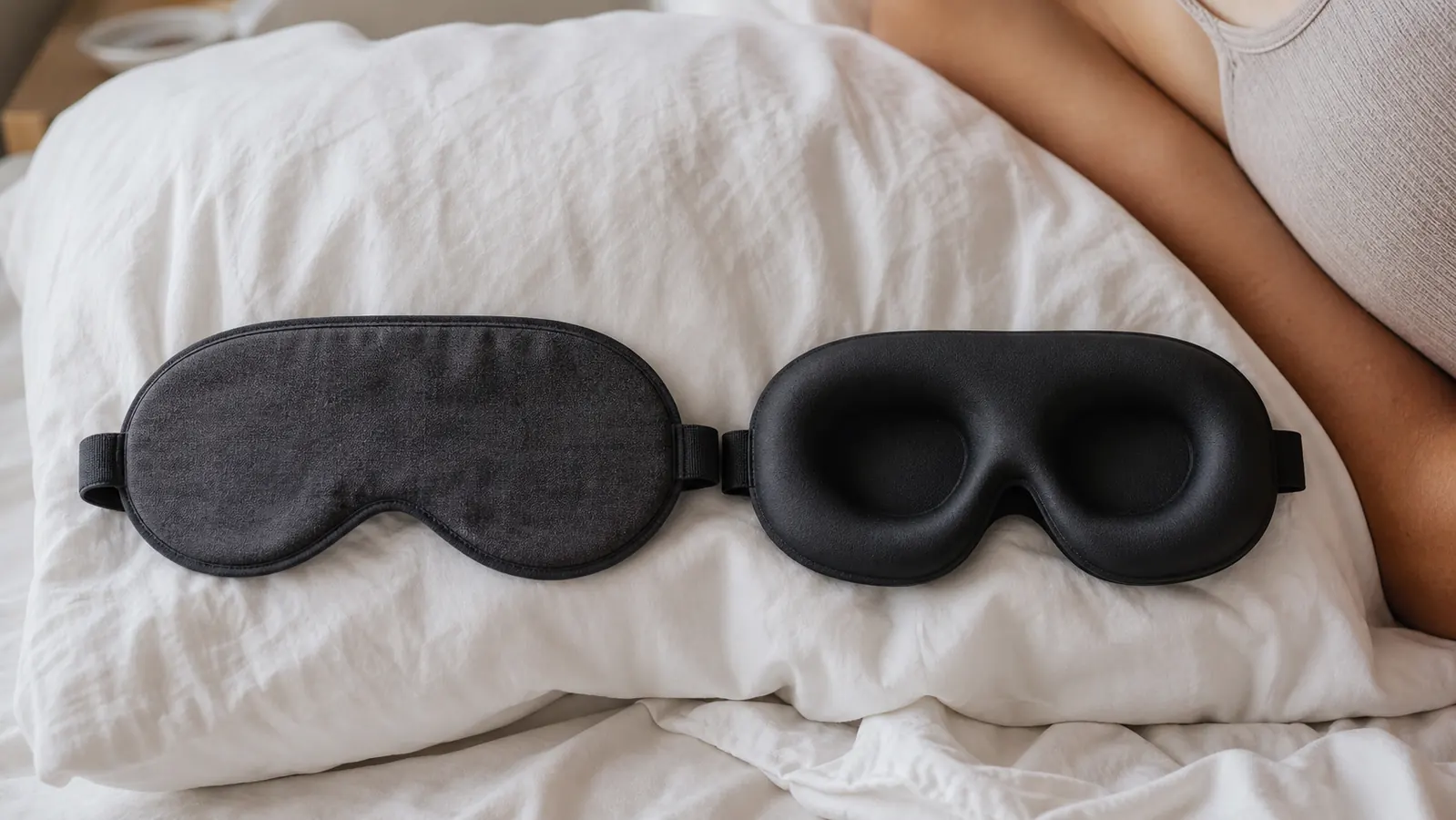
We have tested both the MZOO 3D contoured eye mask and a standard flat foam sleep mask back to back over seven weeks, and the difference between them is not subtle. The MZOO eye mask sits away from your eyelids entirely because the molded dome creates a small cavity over each eye. A flat mask presses fabric straight against your lashes, your lids, and your eyeballs, which sounds obvious when you say it out loud, but you only really notice the problem once you have slept without it.
The short answer: if you care about total darkness, eye comfort, or REM-phase blinking without waking yourself up, the 3D contoured mask is the clear upgrade. If you are packing light for a single overnight flight and already have a flat mask in your bag, that flat mask will do the job. Here is everything we found when we put them side by side.
| Feature | MZOO 3D Contoured Mask | Standard Flat Foam Mask |
|---|---|---|
| Eye pressure | None. Dome floats above lids and lashes. | Direct contact. Fabric presses on lids throughout the night. |
| Light blocking | Near-total blackout. Contoured nose wing seals the gap at the bridge. | Partial. Light leaks in at the nose bridge and outer cheeks on most faces. |
| Blinking room | Full. Eyes can blink and move freely during REM sleep. | Restricted. Lid movement is pressed against the mask surface. |
| Side-sleeper fit | Sits snugly even against a pillow. Dome stays in place on most pillow materials. | Can shift or compress flat when pressed into a pillow, breaking the seal. |
| Strap | Wide elastic with a hook-and-loop adjuster. Fits most head sizes without digging in. | Thin single elastic. Tends to dig or slip, especially for hair-down sleepers. |
| Breathability | Ventilated inner cavity reduces heat buildup around the eyes. | Fabric sits flush, which traps more warmth around the face over a full night. |
| Price | Mid-range. Worth checking today's Amazon price. | Usually lower. Cheapest option for occasional or travel-only use. |
| Lash-friendly | Yes. No contact with lashes means no mascara transfer or lash bending. | No. Direct contact smears lashes and mascara against the mask. |
Where the MZOO 3D Mask Wins
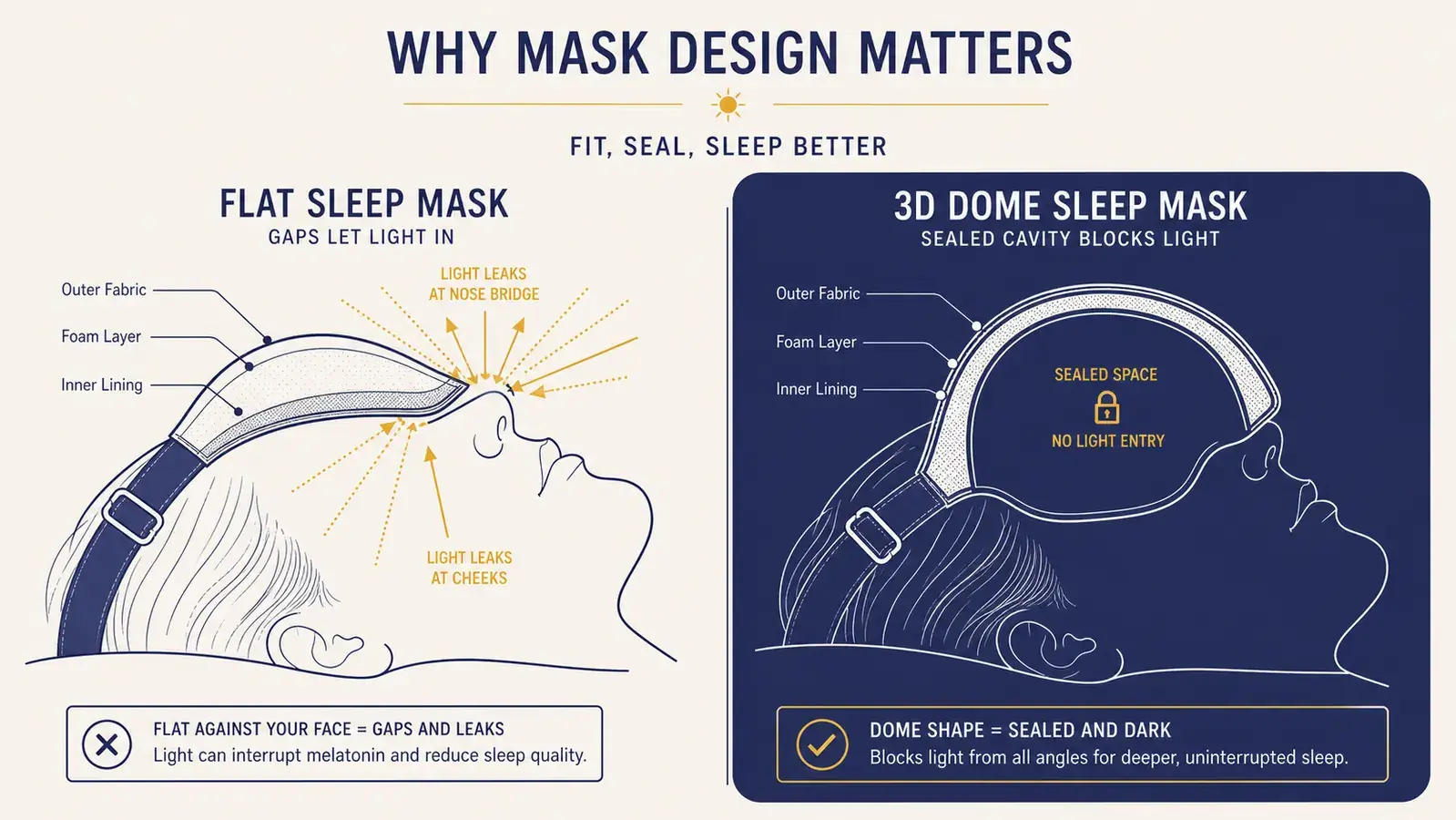
The biggest win is light sealing at the nose. Most flat masks have a straight bottom edge that sits open at the nose bridge, leaving a visible gap where hallway light or early sunrise streams straight in. The MZOO mask uses a contoured nose wing that cups around the bridge and seals that gap against your face. In a room with any light source at all, that seal is the difference between sleeping through sunrise and waking at 6:03 every morning.
The second win is lash and lid comfort. We had a tester with extensions who could not tolerate a flat mask at all because the fabric bent and snagged her lashes within twenty minutes of wearing it. The MZOO dome cleared her lashes entirely. After four weeks she described it as the first mask she has ever worn that she actually forgot was on her face. That is the experience the contoured shape creates for anyone with longer lashes, thicker lids, or anyone who simply wants their eyes to feel rested rather than pressed on all night.
REM blinking is the third factor most people overlook. During REM sleep your eyes move rapidly and your lids flutter. A flat mask pressed against your lids adds resistance to that movement. Some sleepers report waking during REM because the resistance is enough to break the dream cycle. Inside the MZOO cavity there is nothing for your eyes to press against, so that resistance disappears entirely.
The eye cups also protect your lashes in a way the flat mask simply cannot. Every night you wear a flat mask, the fabric is dragging across your lash line as you shift positions. For anyone who wears mascara or has had lash work done, that nightly abrasion adds up. The molded cup holds its shape independent of how you move. Your lashes sit inside the cavity all night without contact, which matters if you are trying to protect any kind of lash investment or just want to stop finding mascara smeared inside a fabric mask each morning.
On the strap, the MZOO uses a wide hook-and-loop closure that you can adjust without fully waking up. The flat mask typically uses a fixed single-loop elastic that digs into the back of the head and, over a full night, leaves a pressure line across your hair. The MZOO strap distributes tension more evenly, though it does have one honest drawback: the hook-and-loop fastener catches in long hair if you wear it down. The fix is simple, a loose bun or braid before bed, but it is worth knowing before you order.
Where the Flat Mask Wins
Packability is the honest answer. A flat foam or fabric mask folds flat into a shirt pocket, a passport holder, or the interior zip pocket of a carry-on. The MZOO mask has a rigid dome that does not compress. It needs its own pouch or a dedicated compartment. If you are traveling with only a personal item and every cubic inch matters, the flat mask earns its place on that basis alone.
Weight reinforces that advantage for travel. A flat fabric mask weighs almost nothing, under 20 grams for most options. The MZOO, with its molded frame, tips closer to 55 grams with the strap. That gap is irrelevant at home, but on a trip where you are carefully managing carry-on weight, a flat mask is genuinely lighter and smaller in every dimension.
Price is the second real advantage. Standard flat masks are widely available at a cost well below the MZOO. If you lose a mask regularly, travel with it in environments where it might get wet or crushed, or simply want a backup for a guest room drawer, the flat option carries very low replacement cost. For home use every single night, the math shifts back toward the 3D mask. But for disposable-level travel use, the flat mask is a reasonable call.
Breathability over a short nap also slightly favors the flat mask. The MZOO's inner cavity traps less heat than direct fabric contact during a full night, but for a 90-minute afternoon nap in a warm room some people find the enclosed dome feels more stifling than a simple piece of fabric laid over the face. If your primary use case is short daytime naps rather than full-night sleep, that is worth factoring in. For anything longer than two hours, the ventilated cavity of the 3D mask wins the breathability comparison again.
Washing is also easier with the flat mask. Most flat foam or cotton masks can be hand-washed and left to air dry flat in minutes. The MZOO has a molded shell that requires gentle hand washing only, and the dome shape means it takes longer to dry thoroughly. It is a minor point for a product you wash once a week or so, but flat masks are generally more forgiving of aggressive cleaning and dry faster when you need the mask back in rotation quickly.
Your eyelids shouldn't be the last thing you feel before sleep. The MZOO 3D mask fixes that.
Near-total blackout, zero eye pressure, and a nose-bridge seal that actually holds. Nearly 100,000 Amazon buyers have landed on it for a reason. See today's price below.
Amazon Check Today's Price on Amazon →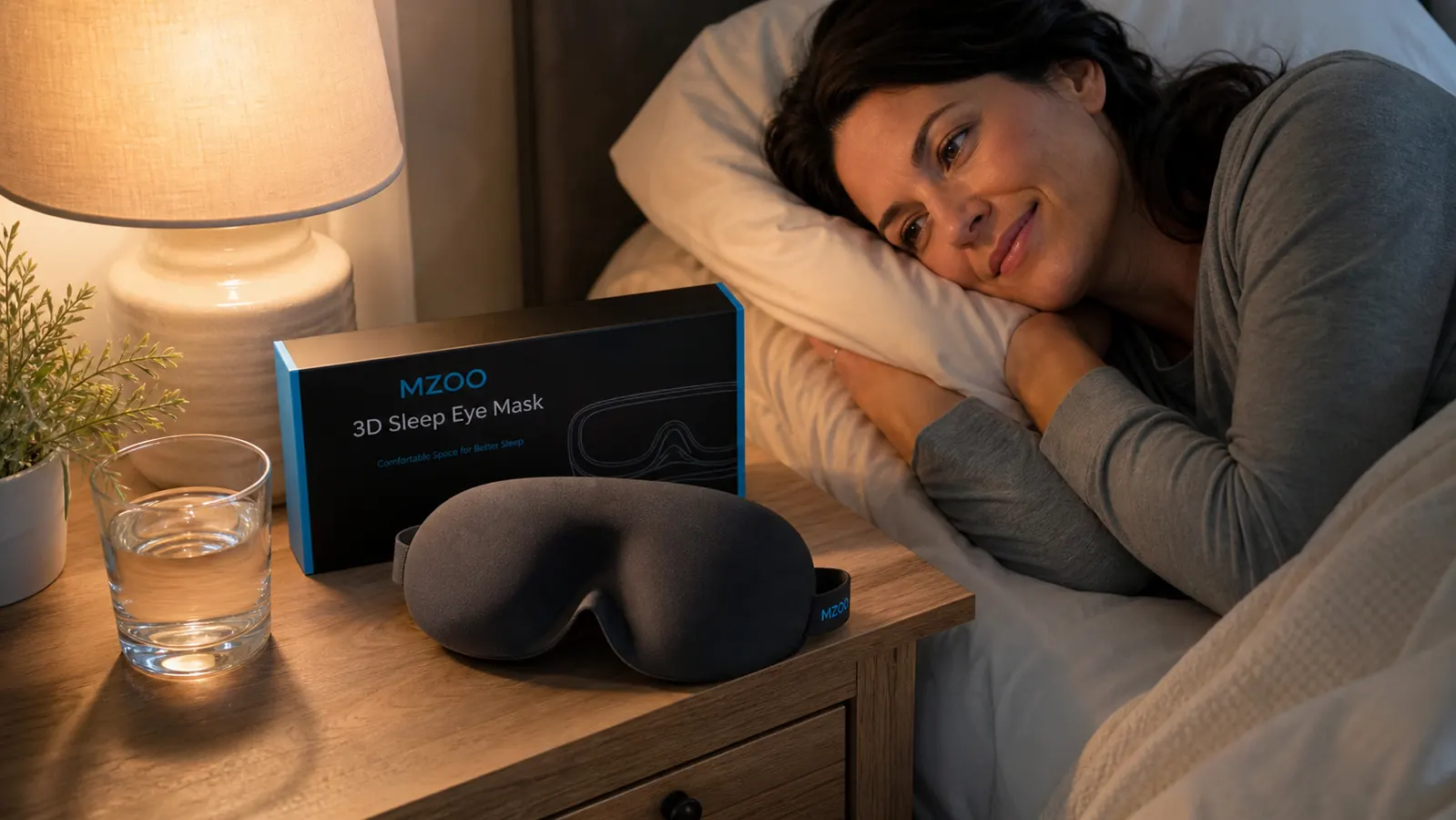
Light Leakage: Why the Nose Bridge Is Where Most Masks Fail
We ran a simple test in a pitch-dark room with a single desk lamp positioned to simulate hallway light under a door. With a flat mask on, a thin band of amber light was visible along the bottom edge of the mask at the nose. With the MZOO mask on, the same light source disappeared. The contoured nose wing does the work here. It is not just about the foam being thicker. It is about the shape routing around the bridge of the nose instead of cutting straight across it.
For city sleepers with a street lamp outside the window, or shift workers sleeping during daylight hours, that light gap in a flat mask is not a minor annoyance. It is often the reason the mask stops working. You put it on, fall asleep, roll slightly, the seal breaks at the nose, and your brain registers the light and starts moving toward lighter sleep stages. The 3D shape reduces how often that interruption happens.
The flat mask pressed on my lashes all night and still let light in at the nose. I assumed sleep masks just worked that way. The contoured one showed me they don't have to.
Side-Sleeper Performance
Side sleeping is the hardest test for any eye mask. When you press your face into a pillow, a flat mask compresses further against your eye and often shifts sideways, breaking the light seal on one side. The MZOO dome is rigid enough that it does not flatten when pressed against a pillow. The dome simply rests against the pillow surface while the foam perimeter maintains contact with your face.
We tested this with both masks over two weeks of side sleeping and tracked how often each mask needed to be repositioned during the night. The flat mask was repositioned roughly four times per night on average. The MZOO was repositioned once, and in some cases not at all. For heavy side sleepers this is the single most practical difference between the two options.
Strap Comfort Over a Full Night
Flat masks typically use a single thin elastic loop that creates a pressure band across the back of the head. Over a full night, that band leaves a visible line in your hair and can create a low-grade headache around the ears and temples. The MZOO uses a wider elastic with a hook-and-loop closure that distributes pressure across more surface area and stays adjustable. We could add or remove tension at 2am without fully waking up, which is a small thing until you need it.
One genuine note on the MZOO strap: it does catch in hair. Sleepers with long hair who wake with the mask pulled toward one side usually find the hook-and-loop closure snagged a few strands. A simple fix is to wear hair in a loose bun or braid when wearing the mask, but it is worth knowing before you order.
How We'd Decide
If you sleep in the same bed most nights and any amount of light bothers you, there is no real decision here. The 3D mask solves the problems the flat mask cannot, and at close to 100,000 Amazon reviews the field evidence is consistent with our own testing. The contoured shape is not a gimmick. It changes the physical relationship between the mask and your face in a way that matters over a full night.
If you are buying for a single trip, a backup guest-room drawer, or a child who needs something lightweight and easy to wash, the flat mask makes more sense. Buy the cheap one, use it, lose it without regret. Where the flat mask fails, specifically at the nose bridge on any face with a prominent bridge, and under pillow pressure for side sleepers, the 3D mask addresses both problems by design. Choose based on whether those failure modes describe the sleep situation you are actually buying for.
Who Should Buy Which
Buy the MZOO 3D contoured mask if you sleep at home most nights, you are sensitive to any light, you have lash extensions or longer lashes, you are a side sleeper who rolls around, or you have ever been frustrated by a flat mask pressing on your eyes. At nearly 100,000 Amazon reviews and a rating of 4.6 out of 5, the feedback aligns with our own testing: most people who switch from a flat mask to this one do not go back. It is the right tool for regular nightly use in an imperfect sleep environment.
Stick with a flat mask if you are buying purely for occasional travel or plane sleep, you need something that folds flat into a small bag, or you want the lowest possible replacement cost for a mask you know you will lose or leave in a hotel room. The flat mask is not a bad product. It is the wrong product for nightly home use, and the right one for the carry-on that has no room for anything rigid.
If you've tried a sleep mask and given up on them, the 3D shape is why it didn't work the first time.
The MZOO mask has near-total blackout, zero lid pressure, and a sealed nose bridge. See current pricing and read what nearly 100,000 reviewers have to say.
Amazon Check Today's Price on Amazon →